The idea is not ours. Commentator Briahna Joy Gray (@briebriejoy) put it plainly on X on November 10, answering Cenk Uygur’s complaint that Democrats hide behind “no one else is running”: “They don’t need ANY alternative to run. They just need to withhold their votes for Jeffries.”
This article tests that idea against the rules and the numbers. It holds up — and the bloc that could do it is bigger than the number it would take.
One note before the two rooms, because the first vote’s secrecy changes what its numbers mean. On PoliVion’s count of the seats called today, 136 of the incoming Democrats are AIPAC-backed — and only about 130 votes are needed to nominate Jeffries in the caucus: nominate, not elect. That ballot is completely private, and nobody in it has to vote for someone else; a member can simply not vote. If all 118 Democrats with no AIPAC tie did exactly that, the nomination would still go through — the bar shrinks with the room — but his tally would come out visibly hollow, and the abstentions would open a bridge: an AIPAC-backed member who does not agree with the wars could stand aside in the same crowd, unseen, with no retribution possible against a ballot no one can read. January allows none of it — no secrecy, no crowd cover. On the floor, on television, on the record, 87 of the 118 have to actually withhold, in public and by name, for the deadlock to happen: the count itself is the strategy. In the private room the numbers bend; in the public room, they rule.
Two votes, two rooms
Two votes get confused here. Both get called “the Speaker vote.” Only one elects anybody.
Room one: the party’s private pick. Closed doors, a secret paper ballot. House Democrats vote on November 18–19; House Republicans elected Jim Jordan their leader on November 10, beating Steve Scalise 106–73 — Jordan is their nominee. The secrecy cuts both ways: an AIPAC-backed member could leave that ballot blank too — or never turn one in — and AIPAC would never know. The money cannot see inside a secret ballot. Room one only nominates: it elects no one, and it binds no one — a member can vote for Jeffries there and still withhold in January. And the numbers do not work in that room anyway: the bar is a majority of those present and voting — about 130 if the whole room votes — and Jeffries’s AIPAC-backed Democrats alone number 136, clearing it by themselves. The not-AIPAC-backed 118 fall short: a challenge there would need a named rival and votes peeled from his own side. The bloc that cannot win the private room is the one that can deadlock the public one — which is why the strategy lives in room two.
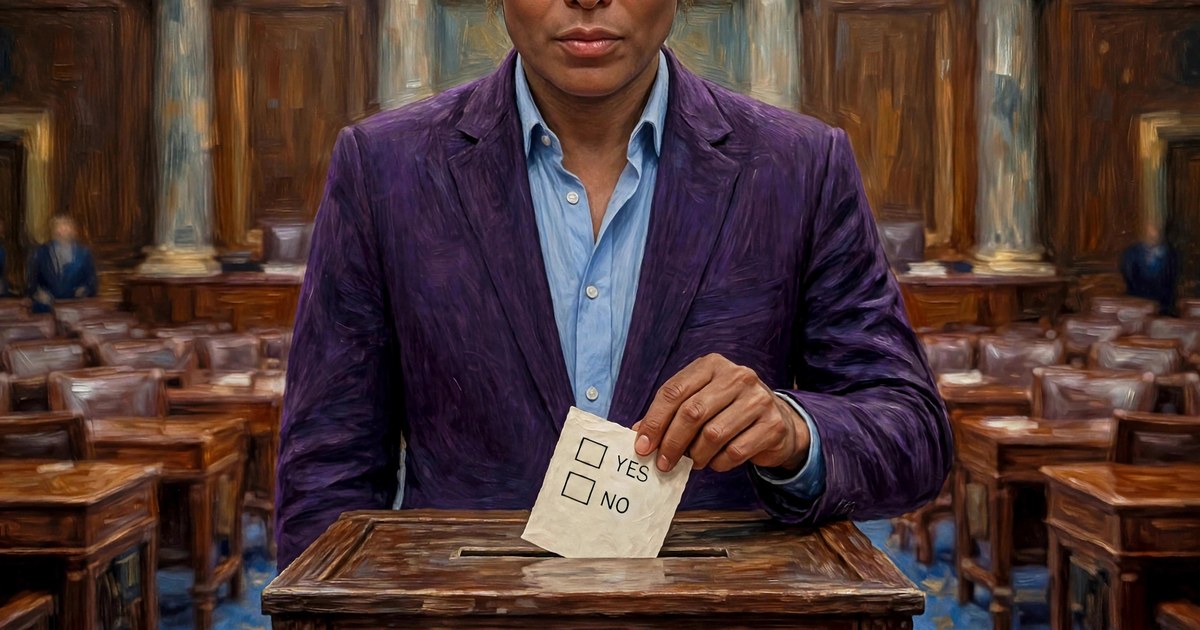
Room two: the election itself. January 3, 2027: the open floor, on television. No paper ballot — the picture above is a symbol; the real vote is spoken. The Clerk calls every name aloud, twice — the second call for those who missed the first. Members answer aloud — a name, or the word “present” — and can still vote until the result is announced.
The winner needs a majority of the votes cast for a person. Not 218. Not half the House. Half the names cast, plus one.
That definition does the work:
- A member can answer “present” — aloud, on camera, published under their own name. It counts for the quorum, not for any person. It lowers the winner’s total, and the number needed to win.
- Stay silent through both calls, or not be there at all. Both end the same way: recorded by name under “Not Voting.” The record never says whether they were across town or in the chamber, silent.
- Nobody can be made to vote: one rule says members “shall vote,” but House Practice says it is not enforced and no Speaker can compel a vote — and on January 3 the standing rules are adopted only after a Speaker is elected.
- If nobody reaches a majority, the House votes again. And again. It can do almost nothing else — members cannot be sworn in until a Speaker exists.
Only in room two does the strategy work: an empty seat there is arithmetic; in room one, an empty ballot is invisible.
McCarthy needed 15 ballots over four days in 2023, winning with 216 after six holdouts voted “present” and his number dropped to 215; Johnson won on the first ballot in 2025, 218–215.
The numbers
Democrats won the House: 254 Democratic winners called, 167 Republican, 14 House races uncalled — read the numbers below as “on the seats called today.”
PoliVion tracks AIPAC-linked money — its PAC’s contributions and contributions routed through it, from FEC filings. Here is the Democratic side:
| Called Democratic winners | Count |
|---|---|
| AIPAC-backed | 136 |
| Backed by another pro-Israel PAC, not AIPAC | 13 |
| Backed by neither | 105 |
| Total called | 254 |
So 118 of the Democrats coming to Washington are not AIPAC-backed. Jeffries is. His AIPAC-linked total is $1,024,341 (2022–2026). AIPAC’s super PAC spent nothing in his race — the tie is direct money.
Now the strategy, run two ways. Assume Republicans vote together for Jordan and everyone else votes for Jeffries.
| Route | How it works | What it takes today |
|---|---|---|
| Vote for another name | Democrats defect to a single alternative | 44 defections leave Jeffries at 210 of 421 cast — short of the 211 needed |
| Withhold | Democrats vote “present” or stay away | 87 withheld votes leave Jeffries at 167, tied with Jordan, with 168 needed |
The first route is where the “roughly 40” figure comes from — Rep. Alexandria Ocasio-Cortez’s number, given to reporters on November 10. It also needs a person to vote for, and no such person is running.
The second route needs more people and nothing else: 87 — about three in four of the 118 not AIPAC-backed. If the 14 uncalled races all break Republican, it falls to 73; if all Democratic, it rises to 101.
The pressure
The push for a clean, unanimous Jeffries vote is happening against a public that is loudly not unanimous.
A Change.org petition titled “House Democrats: CHOOSE A NEW SPEAKER” asks incoming members to vote against Jeffries and others to run. It passed one million signatures on November 7 and stood at 1,094,983 on November 9. One fact travels with that number: its starter, Nicole Whitted, is a Change Ambassador who, Change.org’s own page discloses, receives compensation in connection with it. A million signatures is a petition count, not a poll. It is also not nothing.
The pressure runs in more than one direction:
- From voters, onto the freshmen. The Washington Examiner reports heavy constituent pressure on the incoming bloc to withhold support — inundated phone lines. The bloc’s members are publicly uncommitted — Melat Kiros, Claire Valdez, Darializa Avila Chevalier, Adam Hamawy. Rep.-elect Angela Gonzales-Torres, on the record: “As of right now, my vote is no.”
- From leadership, onto at least one freshman — by his account. Rep.-elect Don Leonard of Ohio flipped a district Trump carried by ten. He says senior Democrats sat him down before he was sworn in and warned him, “in no uncertain terms,” that holding to his conditions for supporting Jeffries “would basically mean both making my life a living hell for the next two years here in Washington as well as being sure to lose my election in two years.” He told it on Instagram and Joy Reid’s podcast, named no members, and his conditions concerned corporate money and American backing of the wars in Gaza and Iran. One member’s account, reported by Newsweek, not independently confirmed; Jeffries’s office has not answered it in the reporting we checked.
- From the mechanics themselves. AOC endorsed Jeffries in October, and on November 10 explained why she thinks none of this matters yet — nobody is running, so “it’s not a race right now” — while saying Jeffries’s refusal to halt Iran war funding should be “absolutely part of the conversation.”
What a withheld vote buys
A deadlock does not elect anyone. That is the point of it, and also its limit. What it does is make room.
Today, the conversation has exactly one name in it. A first ballot with no winner changes everything: a name is suddenly needed, and stepping forward stops being rebellion and becomes rescue. Gray named the trap — start drafting people to run now, and “the establishment will just make them say ’I don’t want it,’ and then we’re back to square one.” Withholding skips that problem: nobody declares, nobody gets talked out of it. The empty votes come first; the opening follows.
Rep. Ro Khanna is the name that comes up most — he is on PoliVion’s own bench of cleaner options. But Khanna has not stepped up. On November 5 he set three conditions for supporting Jeffries — end the Iran war, stop funding Israel, a Medicare for All vote — and promising to push “very, very hard” for them. He has since said that Jeffries “is going to be Speaker of the House with the unanimous support of the Democratic caucus.” “Khanna for Speaker” online is supporter graphics and comment threads — no outlet reports him running. The rest of the bench — Kaptur, McGovern, Casar, Solis — sits in the same posture: available on paper, not one stepped forward.
And none of it is private: between the second call and the announcement, leadership works the window — in January 2025, Norman and Self changed their votes to Johnson inside it, before the tally closed. The 87 would have to hold in public, one name at a time.
The realistic near-term price of a withheld vote is probably not a new Speaker. It is conditions. That is what the incoming bloc is already negotiating — a floor vote on Medicare for All, a moratorium on data centers, an end to American assistance for Israel are the demands Axios has reported from inside the talks, sourced anonymously, on no paper yet. A bloc that can count to 87 does not have to ask politely for those things. A bloc that cannot, does.
Our read
Start with what is documented. The man in line for the gavel has taken $1,024,341 in AIPAC-linked money and voted for the aid packages. The drive for unanimity is a drive to make that fact irrelevant — to seat him before anyone counts the cost. The members with no AIPAC tie are the only ones who can decline that arrangement without crossing a funding relationship of their own. There are 118 of them. The arithmetic needs 87.
Now the part that is observation, not arithmetic. Nobody wants to speak against Jeffries, and nobody seems to want the job either — the floated names keep declining on other people’s behalf. Gray saw the same thing from the outside: name a challenger early and the machine produces an “I don’t want it” by Friday. A strategy that needs no candidate fits a caucus that will not produce one. It asks members only to do the one thing that names no rival and gives leadership no candidacy to run against: stay silent when their name is called — both times — or answer “present,” out loud. Both routes are public, and both are recorded under the member’s own name. What a withheld vote carries is no candidate — not no record.
We published a piece yesterday about a vote this same chamber took on Tuesday — the motion that buried the impeachment articles against Pete Hegseth, 211 to 204, with eighteen members not in the room. Eleven missing Democrats held that outcome. There, absence decided a vote by accident — traffic, timing, a bus. January 3 is the same sum, available on purpose.
None of this says the 118 are a bloc. They are a count, not a coalition. Most of them may be perfectly content with Jeffries. The count only matters if some of them start counting too.
And if the room truly cannot produce a name — well. The Constitution never says the Speaker must be a member of the House — only that the House shall choose one. Members have cast Speaker votes for Colin Powell, more than once, and for Donald Trump — one from Matt Gaetz in 2023. Nobody from outside has ever won. But if no one in the chamber will step up, the door is technically open. We can always elect Hillary.
Sources: House Practice and the House Clerk (Speaker election standard — majority of votes cast for a person, quorum present); U.S. Constitution, Art. I, §5; Briahna Joy Gray (@briebriejoy) and Cenk Uygur (@cenkuygur), X, November 10, 2026; Change.org, “House Democrats: CHOOSE A NEW SPEAKER” (petition page, incl. its Change Ambassador compensation disclosure); NJ Radar Online, November 7, 2026; petition counts of November 9, 2026; New York Beacon and Newsweek, November 2026 (Leonard account); Washington Examiner, Courier Newsroom, and Drop Site News, November 10, 2026 (bloc members uncommitted; AOC endorsement and remarks; constituent calls); Breaking Points, November 5, 2026 (Khanna conditions); Speaker Johnson’s office, November 10, 2026, and AP/Reuters (Jordan elected Republican leader, 106–73); PoliVion election-night tracker, November 11, 2026 (254 Democratic and 167 Republican winners called); FEC filings via FundVoter (Jeffries AIPAC-linked total, 2022–2026); PoliVion, “Will Anyone Challenge Jeffries?”, “Better Options Than Jeffries,” and “The Missing Votes on the Impeachment of Pete Hegseth.”
Why this is on PoliVion
PoliVion follows the money and the paper behind American politics. This article sits where the two meet: a Speaker’s race with no challenger, a million-signature petition, and a count — 118 members with no AIPAC tie, 87 votes needed — that decides whether the race stays uncontested.
Will Anyone Challenge Jeffries? → All PoliVion articles → ← Back to the dashboard