
Start with what this is not. Hillary Clinton is not a candidate. She has announced nothing, formed nothing, and hinted at nothing: her public statements contain no expression of interest in running again, and in the past she has said she does not intend to run for president again. Nothing that follows claims otherwise. This is a case, argued on the record, about the board as it now stands — and about the one figure standing on it whom the money cannot threaten.
The landscape
On Tuesday, Democrats won the House. The fights over who leads the new majority are already open in both chambers — PoliVion has laid out the alternatives in Better Options Than Schumer and Better Options Than Jeffries. Underneath both fights sits the same fact, the one this site exists to track: the incoming Congress is saturated with AIPAC money. By PoliVion’s count from its results tracker, 134 of the House’s incoming Democrats and 139 of its incoming Republicans are AIPAC-backed members. The leadership ladders are funded. The back benches are funded. The money is not an influence on the new Congress; it is a property of it.
Across the ocean, the other fixed point of the last decade just moved. In Israel’s election on October 27, Benjamin Netanyahu’s bloc took 53 of the Knesset’s 120 seats — short of the 61 he needed. The longest-serving prime minister in Israel’s history is fighting to keep his job, in a country whose politics he has dominated for a generation, at the exact moment American politics reshuffles its own leadership.
A presidential run in this landscape runs through that money. Every plausible candidate will be priced, courted, pressured, and tested by the pro-Israel donor network, the way every candidate has been for thirty years — with access granted or withheld, primaries funded or threatened, October ads promised or implied. Every plausible candidate but one. The rest of this article is about the one.
The warrant
On November 21, 2024, Pre-Trial Chamber I of the International Criminal Court issued an arrest warrant for Benjamin Netanyahu, alongside one for his then defense minister, Yoav Gallant. The chamber found reasonable grounds to believe the two men bore criminal responsibility, as co-perpetrators, for the war crime of starvation as a method of warfare and the crimes against humanity of murder, persecution, and other inhumane acts — and, as civilian superiors, for the war crime of intentionally directing an attack against the civilian population. The conduct alleged runs from October 8, 2023, through May 20, 2024. A warrant is an accusation, not a conviction. The Court still lists Netanyahu as at large, and its deputy prosecutor confirmed in September 2026 that the warrants stand.
The warrant’s force is geography. 125 countries are parties to the Rome Statute, and every one of them is obliged to arrest him and surrender him to The Hague if he enters its territory. Some have said they would. Asked on November 22, 2024, whether Netanyahu would be arrested if he came to Ireland, Prime Minister Simon Harris answered: “Yes, absolutely. We support international courts and we apply their warrants.” One member state has already refused: Hungary hosted him from April 3 to 6, 2025, without arresting him — Prime Minister Viktor Orbán used the visit to announce that Hungary would leave the Court — and the Court’s judges formally found that Hungary had failed to comply with its obligations, referring the matter to the Assembly of States Parties.
The United States is not a party to the Rome Statute, and here the warrant has never constrained him — because Washington has worked to ensure it cannot. On the day the warrants issued, President Biden called them “outrageous,” and the White House said the United States “fundamentally rejects” them. The shield then went on offense. On February 6, 2025, President Trump signed Executive Order 14203, sanctioning the Court’s prosecutor, Karim Khan, by name. The designations have since reached judges of the Court, its deputy prosecutors, a United Nations rapporteur, and three Palestinian human-rights organizations — and on October 9, 2026, the United States sanctioned the Court itself. Under that shield, Netanyahu has traveled to the United States at least seven times since the warrant issued: received at the White House again and again, and in September 2026 in New York for the UN General Assembly, his flight crossing the airspace of Greece, Italy, and France, three states parties that let him pass overhead.
One post put the conclusion this landscape points to plainly, that morning — @GirlFromMars_OG, November 7, 2026: “If Hillary Clinton was president Netanyahu would have already been arrested.” Here is that sentence taken apart, as analysis — because the honest version of it is about power, not handcuffs. No American president could arrest him, and none would owe the Court an arrest: the United States never joined the statute. What a president controls is the shield — the sanctions that punish the Court for issuing the warrant, the pressure on allies who intend to honor their own obligations, the standing guarantee of safe and celebrated passage. A President Clinton, on the record that Netanyahu must go and owing the lobby that maintains that shield nothing at all, is the one plausible president who would simply lower it. The warrant would not gain an American policeman. It would lose its American obstacle. His map would shrink to the capitals still willing to host a man the Court lists as at large, and every landing beyond them would become a risk he no longer controls. That is the sentence with its mechanism showing: not that she would put the cuffs on him herself, but that he has never yet had to move through a world in which the United States was not holding the warrant back.
She has said it out loud
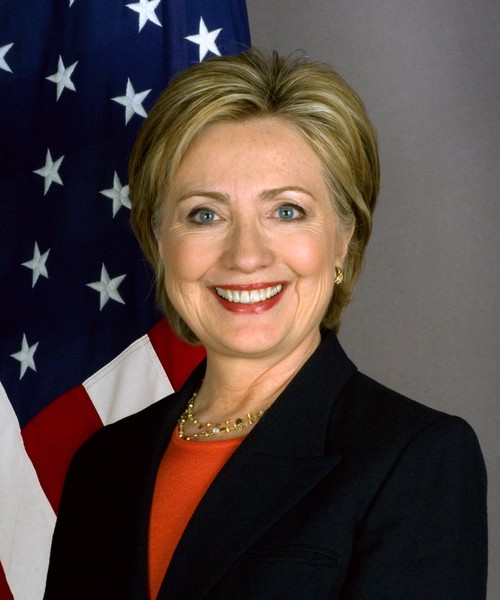
American presidents, secretaries of state, and nominees do not usually say in public that an Israeli prime minister has to go. They say it in memoirs decades later, or through officials who will not give their names. Clinton has said it on television, in a book, and on her own social media — while Netanyahu is still in office, and in words that cannot be walked back. Hers, in her own voice:
On February 7, 2024, on MSNBC’s Alex Wagner Tonight, she said: “Netanyahu should go. He is not a trustworthy leader. It was on his watch that the attack happened. He needs to go, and if he’s an obstacle to a ceasefire, if he’s an obstacle to exploring what’s to be done the day after, he absolutely needs to go.”
Days later, at the Munich Security Conference, CNN’s Christiane Amanpour read those words back to her and asked whether Netanyahu needs to go. Clinton did not soften a syllable: “Yes, he does.”
In her memoir Something Lost, Something Gained, published in September 2024, she wrote that Netanyahu “has taken zero responsibility and refuses to call an election, let alone step down” — and set that against Golda Meir, who after the Yom Kippur War accepted a commission of inquiry and then resigned.
On June 30, 2026, she posted it on her own Threads account, complete, with nothing around it: “Netanyahu must go.”
On August 25, 2026, she said Netanyahu has “seriously damaged, first and foremost, Israel.” And in September 2026, on MSNBC’s Morning Joe, she drew the distinction her whole position rests on, in one sentence: “I love Israel, and I hate Netanyahu’s government and his policies.”
Her husband got to the same place first, in his own way. On September 14, 2014, at the Harkin Steak Fry in Iowa, in front of C-SPAN’s cameras, an activist told Bill Clinton: “Netanyahu is not the guy.” The former president answered: “I agree with that.”
Now the counterweight, because it is part of her record and this article does not trim records. On October 26, 2023 — less than three weeks after the October 7 attack — Clinton spoke at the Baker Institute in Houston and opposed a ceasefire in Gaza, calling one “such a gift to Hamas”, and adding: “People who are calling for a ceasefire now don’t understand Hamas.” Her break is with Benjamin Netanyahu, personally and by name. It is not, and has never been, a break with Israel. Anyone weighing the case for her should hold both facts at once, because both are hers.
Thirty years of friction
The friction predates her own elected career. Netanyahu’s first meeting with President Bill Clinton came in July 1996, weeks after Netanyahu’s first election victory in Israel. What the president said about him afterward survives only as attributed recollection, and it is labeled that way here. Dennis Ross, the administration’s Middle East envoy, wrote in his memoir The Missing Peace that Clinton’s reaction was: “He thinks he is the superpower and we are here to do whatever he requires.” Aaron David Miller, who served under Ross, has told a rawer version of the same outburst. Reported, both of them — and consistent with everything that followed: the relationship between the Clintons and Netanyahu began, thirty years ago, with a president concluding that the prime minister had the hierarchy backwards.
It never warmed. In October 1998, the two governments negotiated for nine days at the Wye River conference center in Maryland and produced the Wye River Memorandum, signed on October 23. The final day nearly collapsed over Jonathan Pollard, the American intelligence analyst then serving a life sentence for spying for Israel. Netanyahu maintained that Clinton had promised to release Pollard; Clinton maintained that he had promised only to review the case. Both claims are on the record, and they cannot both be true. CIA Director George Tenet was reported at the time to have threatened to resign if Pollard were freed — a report that has been contested ever since.
Then there is the chronology, which this article prints as chronology and nothing more. The Monica Lewinsky story broke in January 1998. Wye River was October 1998. On December 19, 1998, the House of Representatives impeached Bill Clinton. Those are dates, and chronology is not evidence of anything beyond itself — a point that matters below.
When it was Hillary Clinton’s turn to hold the relationship, she held it the same way. On March 12, 2010, Israel’s Interior Ministry announced new housing construction in Ramat Shlomo, in East Jerusalem — timed, by design or by incompetence, to land in the middle of Vice President Joe Biden’s visit. Secretary of State Clinton made the call to Netanyahu herself, and it lasted 43 minutes. State Department spokesman P.J. Crowley called the announcement a “deeply negative signal about Israel’s approach to the bilateral relationship.” In her memoir Hard Choices, Clinton described Netanyahu as “a complicated figure”, wrote that on their calls the two “argued frequently”, and joked that she had served as the administration’s “designated yeller.”
What cannot be verified
UNVERIFIED — FLAGGED AS SUCH, ATTRIBUTED TO NO ONE
This section exists because the history above has a shadow version, and readers will meet it elsewhere. PoliVion’s rule for material of this kind is strict: it may be published only if it is explicitly flagged as unverified and attributed to no actor. It is flagged. The claim is this: two published books — Gordon Thomas’s Gideon’s Spies (1999) and Daniel Halper’s Clinton Inc. (2014) — assert that Israeli actors possessed tapes of President Clinton’s phone calls with Monica Lewinsky and used them as leverage over him, including at Wye River, to press for Jonathan Pollard’s release.
Here is the claim’s entire documented status. It was denied at the time: the White House called it “nonsense,” and a spokesman for Netanyahu called it “beyond the pale.” The tapes have never been produced. No official, in the decades since, has confirmed any part of it on the record. PoliVion does not present any of it as fact and attributes it to no one. It is printed so that a reader who encounters the claim can see precisely what it is: an assertion in two books, denied by everyone it touched.
Three documented facts sit near the claim and are sometimes used to lend it weight. They are documented; the claim is not, and their proximity changes that not at all. First, in 1997 American counterintelligence really did run a mole hunt — code-named “Mega” — for a suspected Israeli source with access to sensitive material. Second, Lewinsky testified that President Clinton warned her in March 1997 that he suspected a foreign embassy was tapping his phones; that is her testimony about his statement, not proof that any tapping occurred. Third, the New York Times reported in November 1998 that Pollard’s release was discussed at Wye — which the open record above already establishes. Kernels are not a chain, and nothing documented connects them into the story the two books tell.
The catch
Every figure PoliVion examines gets the same treatment, and making her case does not exempt Clinton from it. Here is her record with AIPAC and the pro-Israel network, in full.
On March 21, 2016, at the height of her second presidential campaign, Clinton addressed AIPAC’s Policy Conference and asked the hall: “are we prepared to take the U.S./Israel alliance to the next level?” She promised a new ten-year defense memorandum of understanding “as soon as possible.” She told the crowd — which gave the line a standing ovation — that “One of the first things I’ll do in office is invite the Israeli prime minister to visit the White House.” On the boycott movement she was absolute: “we must repudiate all efforts to malign, isolate and undermine Israel and the Jewish people.” That was the toll the system charged in 2016, and she paid it in full, in public, on the record.
The year before, on July 2, 2015, she had written to Haim Saban — the entertainment billionaire who became her campaign’s most important pro-Israel donor — that “we need to make countering BDS a priority.” In 2016 her campaign worked to keep the word “occupation” out of the Democratic platform’s Israel plank, and succeeded. One boundary of the record deserves stating exactly: no formal AIPAC endorsement of either of her presidential candidacies exists. AIPAC’s support for Clinton ran through its platform, its conference stage, and its donor network. That support was real, and it was large — it simply did not travel under an endorsement.
Two money figures belong on her record. They are different instruments, measured differently, from different eras, and they are not added together anywhere in this article — no combined total exists. The first is direct industry giving: OpenSecrets codes pro-Israel PACs and pro-Israel individual donors under industry code Q05, and its tally of that giving to her Senate campaigns across the cycles it tracks, 1990–2024, is $2,352,302. AIPAC’s own PAC contributed none of it; that PAC did not exist until 2022. The second figure is outside money, labeled as what it is: Haim and Cheryl Saban gave $12,230,000 in the 2016 cycle to Priorities USA Action, the super PAC supporting her. That was a contribution by two donors to a super PAC — not money given to her campaign, and not money her campaign spent.
| The money | Amount |
|---|---|
| Pro-Israel industry giving to her Senate campaigns — PACs and coded individual donors, OpenSecrets industry code Q05, cycles 1990–2024 | $2,352,302 |
| Haim and Cheryl Saban — contributions to Priorities USA Action, the super PAC supporting her, 2016 cycle (FEC) | $12,230,000 |
And there is the rest of the catch. Clinton was born on October 26, 1947; she is 79 years old, and a campaign in 2028 would put her inauguration, in January 2029, at 81. She has sought the presidency at full stretch twice: she lost the 2008 nomination to Barack Obama and the 2016 general election to Donald Trump. The landscape this article describes is real. So is that history. Both sit on the scale.
Our read
Here is the case, stated as analysis and labeled as such. Every lever of the pro-Israel money machine works through fear. Fear of a funded primary. Fear of donors going quiet. Fear of the super PAC’s ads arriving in October. That is how the machine disciplines candidates it has never spent a dollar against: most of them police themselves, years in advance, in sentences they never say.
None of those levers attach to Hillary Clinton. She holds no seat a primary can take. She does not need a donor network’s permission to be heard. She has already absorbed, twice, at full scale, the worst American politics can bring to bear — and the one threat the machine holds over everyone else, that it can end a career, has nothing left to attach to. She has everything to gain: the job she was denied in 2008 and 2016, this time without paying the toll she paid on AIPAC’s stage in 2016. And she has nothing to lose that she has not already lost twice.
The case is not that she was always right on Israel. Her record is printed in this article — the 2016 speech, the Saban letter, the platform fight, the morning she opposed a ceasefire — and readers can weigh it whole. The case is narrower, and on this landscape it is decisive: she is the only figure at her level who now says out loud, by name, what she actually thinks of Benjamin Netanyahu, and the only one nobody can threaten into silence.
And the case does not actually depend on her running for anything. She could run for president — that is the case this article has made. She could run for Speaker: the Constitution does not require the Speaker of the House to be a member of it. Every Speaker in American history has been one, but the door exists and has simply never been used. Or she could do nothing at all — and it is worth noticing that every quotation in this article was spoken from private life. No office made her say those things, and no one can make her stop saying them.
That is the point. In a party crowded with people quietly calculating what the money will tolerate, a figure with a clear view of what is right and what is wrong on this question — who states it out loud, at full volume, from beyond anyone’s reach — is not a bystander to the game. On every path, including the quiet one, she is a player in it.
Sources: Times of Israel (February 7, 2024); CNN (February 2024); Hillary Clinton, Something Lost, Something Gained (2024); Threads, @hillaryclinton (June 30, 2026); MSNBC (2024–2026); AP and BBC (March 2010); Hillary Clinton, Hard Choices (2014); Dennis Ross, The Missing Peace (2004); Aaron David Miller via Foreign Policy (2010); Haaretz and Politico (September 2014); New York Post (March 1999); Times of Israel (July 2014); AIPAC Policy Conference speech transcript (March 21, 2016); OpenSecrets industry data, code Q05; FactCheck.org, from FEC records (2016 cycle); PoliVion election results tracker (House counts); Israeli Central Elections Committee results (October 2026); International Criminal Court, Pre-Trial Chamber I (November 21, 2024); Reuters and AFP (November 2024); The White House (November 21, 2024); Executive Order 14203 (February 6, 2025); Human Rights Watch (March 2026); Just Security (2026); Al Jazeera (2026). The portrait is Clinton’s official State Department portrait (2009), a U.S. government work in the public domain, via Wikimedia Commons.
The two fights already running
The argument over who leads the new Congress is live in both chambers — and it is being fought, in part, over exactly the money this article is about. PoliVion’s alternatives, in the same format, are the two companion pieces.
The Senate version → The Speaker version → ← Back to the dashboard