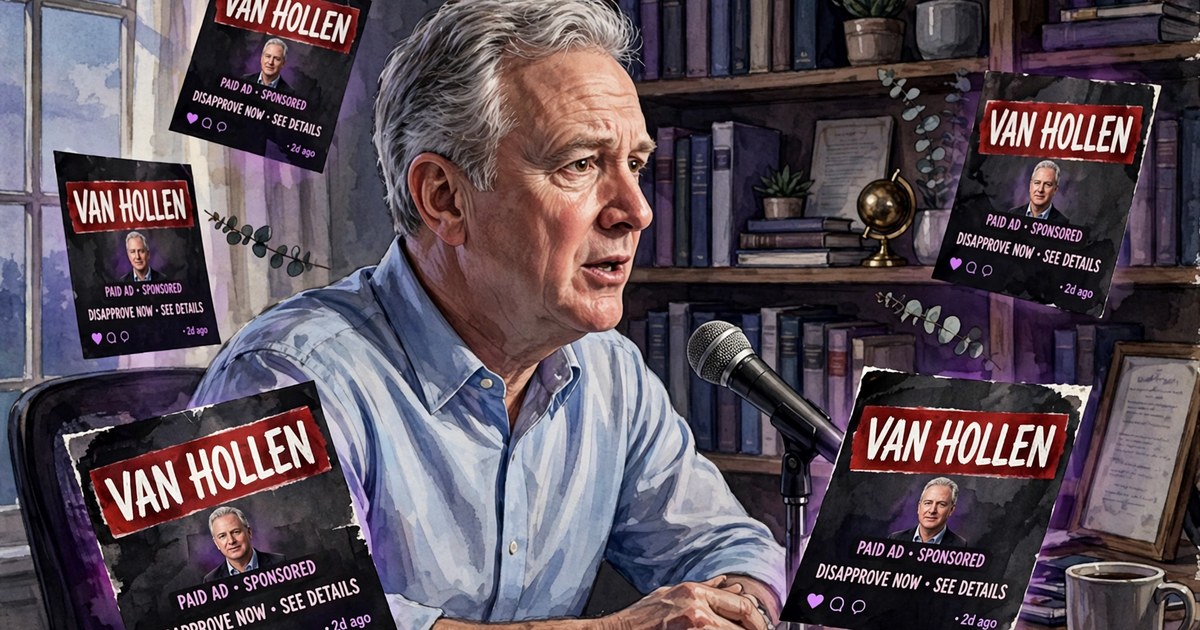
AIPAC spent the year running attack ads against Sen. Chris Van Hollen of Maryland. He was not running for anything. He was not on the ballot in 2026, faced no primary, and his seat does not come before the voters again until 2028. In September, Van Hollen put a figure on the campaign himself: $50,000.
He is running for something now. On November 12, Van Hollen announced that he is challenging Chuck Schumer for Senate majority leader; Senate Democrats choose their leader by secret ballot on December 1 — the first contested election for the job since 1994. But the challenge came after the money. The ads were running by spring, and the campaign against him reaches back to December 2025.
The spending drew wider notice this weekend, when a widely viewed post on X tied the ads to the leadership race. The timeline does not support the connection — and it does not need it. Spending $50,000 against a senator who was running for nothing is the story on its own.
The sequence
December 2025
AIPAC campaigns against Van Hollen are already running, according to the Washington Examiner’s later reporting.
March 2026
Van Hollen tells a J Street convention that AIPAC is “neither pro-American nor pro-Israel.”
May–June 2026
AIPAC runs a weekslong social-media campaign accusing him of feeding antisemitic tropes; the Washington Examiner reports it on June 22.
June 17, 2026
Van Hollen tells NOTUS that Democrats should reject AIPAC money, because AIPAC demands “unconditional support for the actions of the government of Israel, regardless of what those actions are.”
September 1, 2026
Van Hollen posts that AIPAC is spending $50,000 on attack ads against him, “and I’m not even on the ballot this year.”
October 21, 2026
AIPAC tells its members it will stop endorsing candidates, making direct PAC contributions and earmarking funds. Its super PAC keeps operating.
November 3, 2026
Democrats win the Senate majority.
November 10, 2026
Van Hollen tells Zeteo that AIPAC has been running ads against him in Maryland “for about a month.”
November 12, 2026
Van Hollen announces his challenge to Schumer on MS NOW.
November 14, 2026
Van Hollen posts a new video calling the ads “just an opening salvo.” Mark Levin brands him the Muslim Brotherhood’s and CAIR’s preferred candidate for majority leader.
December 1, 2026
Senate Democrats pick their leader by secret ballot.
The ads
The ads are paid for by AIPAC itself — the lobbying organization, not its super PAC. They have run on Facebook and Instagram since at least May, and the Washington Examiner reported they appear directed at Jewish residents of his home state of Maryland. Some of AIPAC’s similar campaigns have carried estimated audiences as large as 1 million users.
One ad quotes the Washington Jewish Week editorial board: Van Hollen “does not have the right to... treat Americans who support Israel as uniquely suspect participants in American democracy.” A form letter attached to the campaign told recipients that Van Hollen is “questioning your patriotism,” and that “calling pro-Israel Americans ’anti-American’ feeds directly into antisemitic tropes of Jewish disloyalty.” Recipients were invited to write and tell him they are proud pro-Israel Americans.
The $50,000 figure is Van Hollen’s own. He stated it on September 1 and repeated it on November 14. No independent filing confirming the total has been found: ads bought by a lobbying organization about a senator who is not a candidate do not appear in FEC filings the way campaign ads do. The mechanism matters, and this page keeps it separate — these are the organization’s own ads, not independent expenditures by its super PAC, United Democracy Project.
What each side says
Van Hollen’s explanation is in his September 1 post: “AIPAC is spending $50,000 on attack ads against me – and I’m not even on the ballot this year. Why? Because I refuse to give a foreign government a blank check or your tax dollars. Their attacks won’t stop me from standing up for what’s right.”
On November 10, he told Zeteo the ads had been running in Maryland for about a month: “And you know what I say? Too bad... You’re not going to persuade me to stop voting in a way that supports human rights and equal dignity for all peoples.”
On November 12, announcing his challenge, he said the Democratic Senatorial Campaign Committee should take no AIPAC money at all, and that “Leader Schumer sided with the candidate who is backed by AIPAC and crypto” — pointing at the Michigan and Maine primaries, where the AIPAC-backed candidates lost to Abdul El-Sayed and Troy Jackson anyway. On November 14, in a new video, he said AIPAC wants senators who will provide “a blank check of billions of dollars of American taxpayer money to the government of Israel,” and called the current ads “just an opening salvo.”
AIPAC’s stated charge, in its own campaign, is the disloyalty-tropes claim quoted above. About its October 21 decision to end endorsements and direct PAC giving, spokesperson Deryn Sousa told NPR that the group’s mission and strategy remain the same, and that organized giving by its members — more than $90 million this cycle, by its count — “will continue and increase.”
Schumer says he already has the votes to remain leader. Van Hollen says more than ten senators are backing him. Neither count is public, and the ballot is secret.
On November 14, Fox News host Mark Levin branded Van Hollen the Muslim Brotherhood’s and CAIR’s preferred candidate for majority leader. There is no evidence for the label. Nothing in the public record ties Van Hollen to the Muslim Brotherhood — no membership, no affiliation, no money. The same label was used against El-Sayed throughout the Michigan Senate race; Bridge Michigan’s fact check of that claim found no evidence for it either.
The money
The direct contributions are the part of this that sits in federal filings. They are one mechanism only — AIPAC’s PAC writing checks — and they are not combined here with any other kind of spending.
| Candidate | AIPAC PAC direct contributions, 2021–2026 |
|---|---|
| Chuck Schumer | $101,070 |
| Chris Van Hollen | $0 |
| Total | $101,070 |
Schumer’s total arrived in 2022, his last election year. Van Hollen, whose seat is next before the voters in 2028, has received nothing and says he wants the party’s campaign arm to refuse the money outright. United Democracy Project, AIPAC’s super PAC, has spent nothing in a Van Hollen race — he has not had one since 2022. And as of October 21, AIPAC says the direct-giving tool itself is being retired after this cycle.
Our read
The documented part of this story is the order of events. Pressure first, challenge second. The ads were running by spring; the $50,000 post is dated September 1; the challenge is dated November 12. Any account that makes the ads a move in the leadership race has the arrow pointing backwards.
What the ads were for, on the record, is a position. AIPAC’s campaign answers Van Hollen’s speeches; Van Hollen says the campaign answers his refusal. Both sides describe the same fight. Neither side describes an election — because there wasn’t one.
Underneath the sequence sits a prior question: what is political spending for, when there is no election? The system’s own defense of campaign money is that it informs voters making a choice. Here there is no choice to inform. His name is on no ballot until 2028. Money spent against a man who is not running cannot be addressed to voters at all — it can only be addressed to the man himself, and to the colleagues watching him.
A candidate under attack has a campaign, a war chest and a race — the means to answer inside the same system. A senator between elections has none of those, and the spending against him does not even enter the system built to disclose it. There is no filing for the $50,000, no report a citizen can pull, because the disclosure laws are written around candidacies, and he is not one. The hole in the ethics and the hole in the paperwork are the same hole.
Pressure on officeholders between elections is as old as lobbying, and lobbying at least carries a name, a registry and a target vote. This borrows the form of a campaign — attack ads, a named target, a running total — while answering to none of the campaign rules. Campaign force, with lobbying’s invisibility.
The effect is a separate question from the intent, and the effect is observable. Since November 12, a year of ads against one senator has been hanging over a secret-ballot vote in which that senator is the challenger and the incumbent is a man AIPAC’s PAC has funded. Every senator weighing a vote can see what sustained defiance costs. That is not a claim about why the ads began. It is a description of what they now do.
Read as a pattern, the year of spending also works as insurance. AIPAC did not need to know Van Hollen would announce on November 12; it needed only to see what was already visible — that if Schumer were ever challenged, the challenger was foreseeable. Van Hollen stood first on the bench of alternatives this site published before he announced, and through the fall he was publicly refusing to rule a challenge out. Insurance is not bought after the fire. It is bought steadily, in advance, against the risk already in view — and when the risk arrived, the policy was already in force: a year of ads on file, and a price on defiance the whole caucus had already seen.
And the interest being insured is not a domestic one. AIPAC is an American organization, and says so — its stated mission is to strengthen the relationship between the United States and Israel. But the policy the discipline protects is a foreign government’s. A year of spending, in American form, aimed at an American officeholder who was running for nothing — because he would not sign what he calls a blank check to that government.
The labels escalate with the stakes: antisemitic tropes in June, the Muslim Brotherhood’s candidate in November. A label that large does its work before any argument begins — it tells the audience the man can be dismissed without being heard. There is no evidence behind the largest label. There never seems to need to be.
On December 1, the caucus votes in secret, and the ads cannot cast a ballot. They were never aimed at the vote. On the record since last winter, they are aimed at the price of being the one who says no.
Sources: Washington Examiner, June 22, 2026 (AIPAC’s ad campaign; campaigns dating to December 2025); Sen. Van Hollen, posts on X, September 1 and November 14, 2026, and interviews with NOTUS (June 17, 2026), Zeteo (November 10, 2026) and MS NOW (November 12, 2026); NPR, October 21, 2026 (AIPAC’s letter to members); CNN, November 12, 2026 (the challenge and the December 1 vote); Mark Levin’s remarks as reported November 14, 2026; Bridge Michigan fact check, 2026 (Muslim Brotherhood claims in the Michigan Senate race); Federal Election Commission records, AIPAC PAC disbursements 2021–2026, as compiled by ChooseWell, November 14, 2026. The $50,000 figure is Sen. Van Hollen’s; no independent filing confirming the total was found.
Why this is on PoliVion
PoliVion follows the money and the pressure behind American politics. Here both are visible in a single sequence: a year of ads against a senator with no election to lose, a leadership challenge that arrived afterward, and a December 1 vote that will be counted in secret.
Better Options Than Schumer → The Flip Side — The Speaker Strategy → All PoliVion articles → ← Back to the dashboard