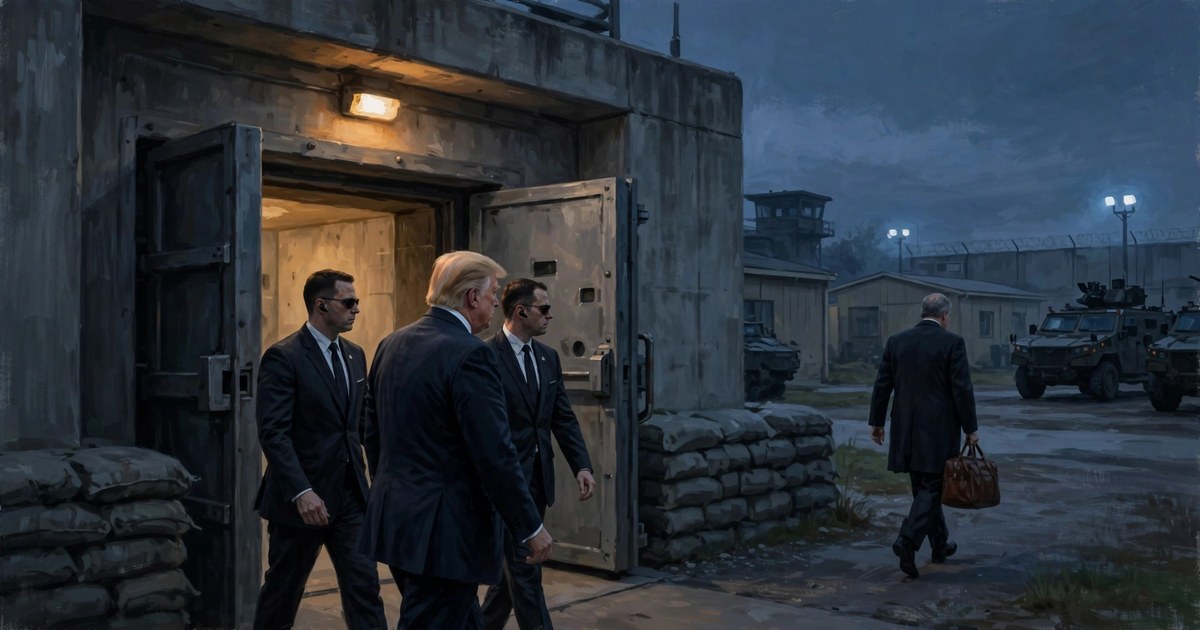
On Saturday, Israel Hayom reported that the Mossad has warned the CIA of an Iranian plot to kill the president of the United States with explosive-laden drones. Every source behind that report is anonymous. The officials who described it are unnamed. The Western intelligence agency said to corroborate it is unnamed. And how the Mossad collected the intelligence — a human source, an intercept, anything — has not been disclosed at all.
The effects are not anonymous. A Treasury secretary has moved out of his home onto a military base. The president has made no open public appearance since Veterans Day. And a peace channel his own vice president spent the fall building was closed by the president himself, in public, two days before the warning appeared in print.
No government has confirmed the plot on the record — not the White House, not the CIA, not the Secret Service, not Israel’s. What can be checked is the sequence, the sourcing, and the pattern. All three are in the public record, and they are the story.
The sequence
July 8, 2026
After an Israeli warning of a missile plot, Trump is secretly switched from Air Force One to a smaller C-32A at Ankara airport.
August 13, 2026
The Washington Post reports the Ankara intelligence was “Israeli-derived, not US-generated, and viewed as low confidence.”
October 2026
Vice President Vance writes to Iran’s Mohsen Rezaei requesting a face-to-face meeting.
November 9 and 11, 2026
Trump tells reporters escalation “won’t be necessary” and that Iran, militarily, is “effectively over.”
November 10, 2026
The New York Times reports Treasury Secretary Bessent has moved from his home to a military base.
November 11, 2026
Trump authorizes Vance to pursue direct talks; Rezaei, who disclosed Vance’s letter, has called the negotiation claims a “pure lie.”
November 12, 2026, 8:07 a.m. ET
Trump kills the channel on Truth Social: “We don’t need a deal with Iran.”
November 13, 2026
Mossad Director Gofman meets CIA Director Ratcliffe in Washington; Bessent confirms his move on CNBC.
November 14, 2026
Israel Hayom reports Mossad’s warning of an Iranian drone plot against Trump and senior officials.
December 6, 2026
Deadline for Gadi Eisenkot to form a government in Israel; Netanyahu remains prime minister while the mandate runs, on a bloc of 53 of 120 seats.
The warning
Israel Hayom’s report, published November 14, says the Mossad passed the CIA specific intelligence indicating that Iran intends to target President Trump and senior members of his administration, including with explosive-laden drones — a method the paper notes is hard to stop with conventional protective security. A second Israeli outlet, Ynet, reported the same day that Israeli intelligence had given Washington specific information about alleged Iranian drone-attack plans. That is a second report that a warning was passed. It is not independent confirmation of a plot.
Read the sourcing closely, because the sourcing is the whole document. The paper cites unnamed senior Israeli and American officials. The corroboration is attributed to another Western intelligence agency, which is not named. And the verification, per the officials themselves, worked like this: US agencies asked the Mossad to check the material, and the Mossad — the source of the material — confirmed it. At no point in the chain does anyone outside the source examine the evidence, and at no point is any link in the chain named.
The report contains no details of when an attack was planned, where it would happen, or who would carry it out. It does not say where a drone attack would be launched from. Every version of the story now circulating traces back to this single newspaper report. As of Sunday afternoon, no government had confirmed the plot on the record, and Iran — which denies plotting attacks on US soil as a standing position — had issued no response to this report specifically.
The report landed the day after Mossad Director Roman Gofman spent Friday, November 13 in Washington, where he met CIA Director John Ratcliffe. Axios reported the visit, the Jerusalem Post confirmed his arrival, and he was expected to travel on to Miami to meet White House envoy Steve Witkoff. Mossad, the CIA and the White House all declined to comment, and no source states that the plot intelligence changed hands in that meeting — the visit and the report coincide, and that is all the record shows. Gofman took over the Mossad in June, after two years as Prime Minister Netanyahu’s military secretary, and is described across the coverage as one of Netanyahu’s closest confidants.
The security effects are documented. Treasury Secretary Scott Bessent moved from his home to a military base — the New York Times reported the move on November 10, and Bessent confirmed it himself on CNBC on November 13: “I follow the Secret Service instructions and have moved from my home to a military base.” He ties the threats against him to the sanctions campaign he has run against Iran since August. Other cabinet members also live in military housing, but Secretary of State Rubio and Defense Secretary Hegseth moved early in the president’s second term, long before this warning — only Bessent’s move is recent, and his own account is what explains it. The president’s last open public appearances were on Veterans Day, November 11, at Arlington and his Virginia golf club; he held closed meetings the next day, kept posting through the weekend, and canceled a planned Saturday golf outing. A late-October memo from the Director of National Intelligence warned that Iranian plots against US personnel had reached an “advanced stage”; Reuters saw the memo. That general warning is documented. The specific drone plot is a different claim, and it is not.
The pattern
This is not the first warning of its kind. In July, at the NATO summit in Ankara, Israel conveyed intelligence to the CIA alleging an Iranian plot against the president on Turkish soil: operatives who knew his hotel and motorcade movements, and a shoulder-fired missile that might be used against Air Force One near the airport.
The United States acted on it at maximum visibility. On departure day, July 8, the president of the United States was secretly moved — through a catering truck — from Air Force One to a smaller C-32A military aircraft. Trump later confirmed the swap and said he followed the Secret Service’s direction. After the departure, no militants were detained, and no physical evidence of a missile plot was recovered.
Five weeks later, the American assessment surfaced. The Washington Post reported on August 13 that US intelligence officials were skeptical: a US official described the intelligence as “Israeli-derived, not US-generated, and viewed as low confidence.” CIA analysts did not find it compelling, and said so to the administration. And the Post reported the sentence that frames this entire story: “Some US intelligence officials saw Israel’s sharing of the warning about threats to Trump’s life as designed less to inform than to influence the president’s decision-making and US policy in the region.”
Turkish officials, speaking to Middle East Eye, said they believed the Ankara warning was a ruse to derail diplomacy between Washington and Tehran. Iran’s foreign minister, Abbas Araghchi, answered on X: “Worse than fake news is fake intelligence.” Both are interested parties, and both are labeled here as what they are. What is not a matter of position is the reported series: an August Jerusalem Post report, citing Reuters, said the US had received several warnings from Israel over the past year that Iran wanted to kill Trump, and US intelligence officials could not verify them on their own.
The view from inside
The sourcing problem has now been described from inside the room — by the man who ran the National Counterterrorism Center until he resigned in March, over this war. Joe Kent’s account is his own, and it is presented here as his account. He told it on the Shawn Ryan Show on November 12, after he had left the government.
Kent says the core failure was labeling. Iran intelligence briefed to the president was, in his words, “never being explained to the president that that information, lock, stock, and barrel, all came from Israel.” He says he and the Director of National Intelligence, Tulsi Gabbard, worried together that intelligence reaching the president was not labeled with where it came from.
He describes interjecting in an Oval Office briefing to say exactly that — that the Iran information all came from the Israelis, and that “we really don’t have a lot of unilateral, like our own intelligence collection, that can confirm or deny it.” By Kent’s account, CIA Director Ratcliffe pushed back in the room but “couldn’t present anything” — and on Kent’s way out, he was told he would not be needed at the next briefing. Ratcliffe’s pushback is part of Kent’s own telling; no other named participant has corroborated the exchange. Kent’s interest is also on the record: he resigned in protest over the war and is now arguing publicly that it was entered on Israeli-sourced intelligence. A reader can weigh that. What cannot be weighed is the underlying intelligence, because no one outside the chain has seen it.
What a real case looks like
Iranian plots against American officials are not imaginary, and the documented ones look nothing like this. They have names, court filings, and paper trails.
On November 8, 2024, the Justice Department charged Farhad Shakeri, described by prosecutors as an IRGC asset living in Tehran. The unsealed complaint says Shakeri told FBI agents himself that an IRGC official had directed him the month before to come up with a plan to kill Trump. A named defendant. His own statements, given to federal agents. A document any citizen can read.
Asif Merchant, a Pakistani national, was charged in August 2024 in a murder-for-hire scheme aimed at US officials; the “hitmen” he tried to hire were undercover officers. On March 6, 2026, he was convicted of terrorism and murder for hire. A third case — an IRGC member charged in 2022 over a plot to murder John Bolton — follows the same shape.
That is what a substantiated plot looks like: a defendant, a docket, evidence a court can test. The drone warning has none of it — no defendant, no filing, no location, no date, no described evidence, and no official willing to stand behind it in public. It may still be real; intelligence warnings can precede cases by months. But today, the entire public basis for moving a president’s movements, a cabinet secretary’s address, and a foreign policy is a single newspaper’s anonymous sourcing.
Our read
Start with the benefit, because the benefit is arithmetic. An Iranian attack on Donald Trump this month would be the single most useful event available to the people urging this war — and the most damaging one available to Iran. It would end, overnight, the American reconsideration of the war: a president publicly calling the war “effectively over,” his vice president running a peace channel, his own former counterterrorism chief telling millions of listeners that the war’s intelligence was Israeli-sourced and unverifiable, and a governing party that has just lost the midterms with the war as a live argument inside its own coalition. An attack would answer every one of those arguments at once. Iran’s documented conduct this same weekend points the other way: drone attacks on a US military base in Bahrain — military targets, in the Gulf, claimed openly by the IRGC under its own name.
Now run the effects in the other direction. Every documented consequence of the warning lands on the same side of the ledger. The peace channel closed on November 12, before the warning was even published. Israel Hayom’s own officials say the threats have sharply reduced the chances of even a preliminary agreement. The president’s public movements are curtailed; his Treasury secretary sleeps on a military base. And the government pressing Washington to resume the war is led by a prime minister whose bloc holds 53 of 120 seats while a rival works a mandate to replace him — a mandate that expires December 6. A war footing freezes that math. A peace deal does not.
None of this proves the warning is false. It proves something narrower, and for a reader more important: the claim is built so that it cannot be checked, and it works whether it is true or not. Unnamed officials. An undisclosed collection method. Verification performed by the source itself. Corroboration by an agency no one will name. A government that acts on the warning in public and confirms none of it in public. If the plot is real, this is a strange way to protect a president. If it is not, it is a perfect way to move one.
Take the warning as true, then, and it still fails — because what the president was given is not, in any usable sense, information. It carries no when. It carries no where. It names no who and describes no method: nothing a protective detail can act on, no route to change, no venue to harden, no person to look for. A protective service cannot protect a man against a date that was never given.
What it can do is move him — and it did. His public movements narrowed. His posture hardened. A peace channel closed. The warning was specific enough in its effects to produce all of that, and too vague to protect him from anything or to be checked by anyone. A claim does not need details to change what a president does. It only needs them to be examined.
That is not acceptable from any direction. If a friendly service is picking up information of this kind, the president is owed a detailed report — the standard every substantiated case in the record already meets, with named defendants, filed complaints, and evidence a court can test. Specifics are what separate protection from pressure. A warning that can move a president but cannot be examined is not protection. It is leverage.
Nor are the details missing for want of capability. Israel’s intelligence services are, by common account, among the most capable collection organizations in the world. A service that can detect a plot of this kind can detect its parts — the time, the place, the method, the people. If the threat is real, the specifics exist. There is no plausible version of a real plot in which the warning exists and the details do not.
So the vagueness is not a limitation of collection. It is a property of the delivery. An ally that is looking out for a president, delivering a warning of this gravity, puts the detailed information together and hands it over with the warning — that is what looking out for him would look like. What the president received was the conclusion alone. The gap in this warning is not what could not be learned. It is what he was not given.
There is one more consequence, and it belongs to the future. This warning cannot be spent later. If an attack ever does come — a year from now, against any target — this report cannot be cited as the reason a response was justified, as though a credible warning had been on the record all along. It was not on the record. It appeared in a newspaper, attributed to no one, describing a plot with no date, no place, and no evidence anyone outside its source has seen.
Credibility is earned with specifics at the time, or it is not earned at all. It cannot be granted afterward, retroactively, to a claim that was never examinable when it was made. A plot with no names, no details, and no paper trail, delivered by a government positioned to benefit from the war continuing, cannot be held credible — not now, while it is moving a president, and not later, if it is ever asked to carry the weight of what happened next.
PoliVion’s rule for stories like this one is printed on our other pages, and it applies here in full: when an interested party stands behind information, the reader should be told whose information it is — in the piece, every time. This warning’s information belongs to the intelligence service of a government that is asking the United States to resume a war. That fact is not a reason to dismiss it. It is the first fact a reader needs in order to weigh it — and in the version of this story that reached the public, it was the fact left out.
That being said — we are glad the president is being kept safe. Precautions cost little, and no one should begrudge them. But the delivery of information at this level is unacceptable — anonymous, detail-free, unexaminable.
None of this is partisan. It does not matter whether the president is a Republican or a Democrat — this kind of communication from an ally of a president is not acceptable, and we hope nobody would be partisan about it.
What is accepted here sets the standard. A delivery accepted at this level becomes the level at which another country may interact with our government — anonymously, without details, without evidence shown. And this is the delivery that comes back on American support: money for a war that we are providing them. That is the exchange as it now stands. It should not stand.
Sources: Israel Hayom, November 14, 2026 (the drone-plot report; unnamed senior Israeli and American officials); Ynet, November 14, 2026; Iran International, November 14, 2026; Axios, November 13, 2026 (the Gofman visit; Netanyahu’s pressure to resume the military campaign); Jerusalem Post, November 13, 2026, and August 14, 2026 (citing Reuters, on the series of warnings); Washington Post, August 13, 2026 (the Ankara warning and the “low confidence” assessment); Middle East Eye, July–August 2026 (the Ankara intelligence’s origin; Turkish officials); New York Times, November 10, 2026 (the Bessent relocation); CNBC, November 13, 2026 (Bessent’s confirmation); USA Today, November 14, 2026, and the Times of London, November 13, 2026 (military-housing timing); Wall Street Journal, November 11, 2026 (the Vance–Rezaei channel and the October letter); Al Mayadeen, November 10, 2026 (Rezaei); Truth Social, November 12, 2026, 8:07 a.m. ET (the president’s post); The Shawn Ryan Show, episode 356, November 12, 2026 (Joe Kent’s account); US Department of Justice (the Shakeri charges, November 8, 2024; the Merchant conviction, March 6, 2026); Reuters (the Clayton memo; Iran’s standing denial of plots on US soil); PoliVion’s published Israel election coverage (the 53-seat bloc and the Eisenkot mandate). As of Sunday afternoon, November 15, 2026, no government had confirmed the alleged drone plot on the record, and Iran had issued no response specific to the report.
Why this is on PoliVion
PoliVion follows the money and the pressure behind American politics — and the information both travel on. This story has no campaign money in it. It has something upstream of money: a warning no one will sign, moving a president, a cabinet, and a war. When information stands behind a policy, the reader should know whose information it is.
The Whiplash of SPY → The Mandate Goes to Eisenkot → All PoliVion articles → ← Back to the dashboard