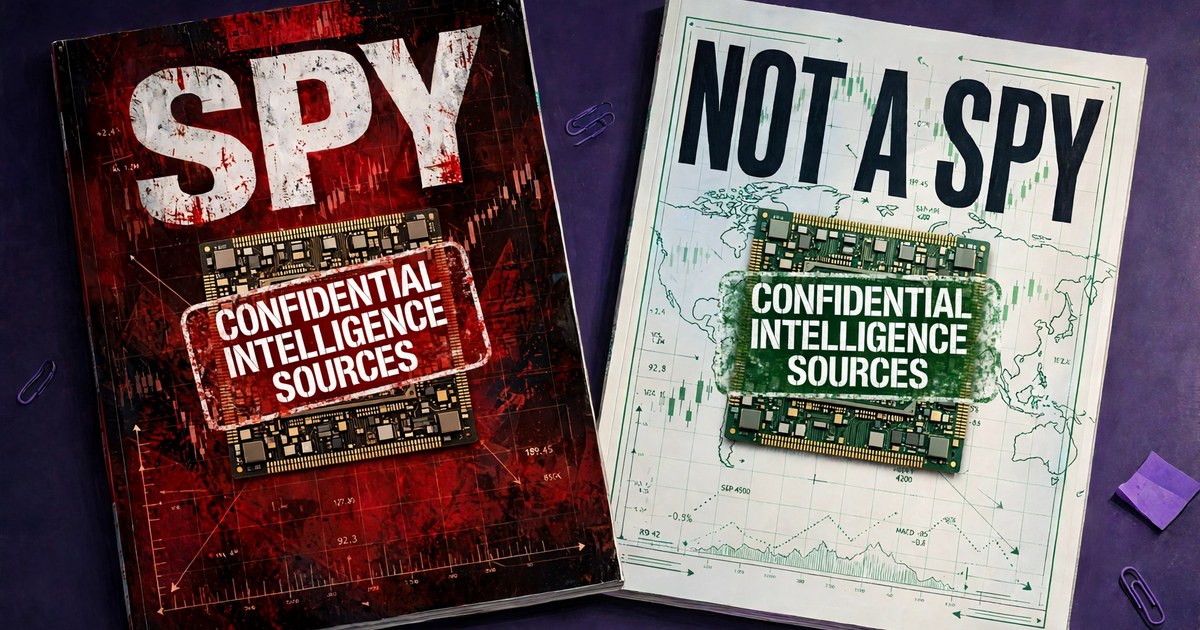
The head of the world’s biggest chip company admitted an affair and lost his job in five days. The claim that started it — that the woman was a Chinese spy — was never proven. This is how the story ran anyway: who said what, in what order, who made money — and why it ran the week it ran, after a year of silence.
What’s on this page
Published November 13, 2026, built from the public record and named reporting. Where a claim rests on anonymous sourcing, the article says so in place. Companion to Where We’re Falling Behind.
Jensen Huang ran Nvidia for 33 years. Nvidia makes AI chips and is the world’s most valuable company. On Sunday, November 8, he told his staff he had been unfaithful. On Wednesday, November 11, his board accepted his resignation. Nvidia announced it Thursday, November 12.
The engine was a word: spy. On October 29, the New York Times reported that U.S. intelligence agencies had concluded Alice Huang — an executive at Megaspeed, a Singapore company that buys enormous amounts of Nvidia equipment — worked for China’s spy agency, the MSS (Ministry of State Security), and that Jensen Huang was her target, according to unnamed officials. Its evidence has never been made public.
On November 12 — after Huang was gone — CNN reported the intelligence community was not sure. The attorney general said no conclusions had been reached. The official position today is not proven. That is not disproven. It is also not what the headlines said.
This companion to Where We’re Falling Behind labels each link documented, reported, or alleged — and asks who had money on it.
February 2025
Singapore police open an investigation into Megaspeed’s server purchases — paperwork declarations, not espionage.
2025
U.S. intelligence is watching Alice Huang’s communications, and the FBI’s investigation runs for at least a year before the public hears any of it.
May 2026
A classified memo overseen by Secretary of State Marco Rubio concludes Alice Huang is a Chinese spy; it circulates to senior officials, and Rubio briefs President Trump aboard Air Force One before Huang joins Trump’s China trip. Huang himself is never warned — and nothing reaches the public for five months.
October 29
The Times investigation: agencies watched Alice Huang’s communications for at least a year, concluded she worked for the MSS, and counted Jensen Huang among her contacts. Headline: “Nvidia Chief, Jensen Huang, Is Seen as Target of Chinese Spy Plot.”
November 6
The Times: officials said the MSS recruited her to collect information on Huang. The Financial Times: a classified memo called their relationship romantic.
November 8
Huang tells staff he was unfaithful; names no one. The board opens an independent investigation into whether he was the target of a “foreign intelligence effort,” saying it has “no reason to believe that either national security or NVIDIA secrets were compromised.”
November 11
The Times reports a second relationship, with Kimberly Powell, a Nvidia vice president and Huang’s direct report. Source: five anonymous Nvidia people; two said the pair was filmed being affectionate at a San Jose hotel in March. The Times has not seen the video. No one named has ever confirmed it — not Huang, not Powell, not Nvidia. Powell did not respond to reporters; Huang, reached by phone, told the Times, “I don’t think you should be talking to me directly,” and hung up. The board meets that evening.
November 11
The board accepts Huang’s resignation, effective that day. Colette Kress, finance chief since 2013, becomes interim CEO — temporary boss while the board searches for a permanent one.
November 12
Nvidia announces the resignation; its filing gives no reason. CNN publishes the walk-back later that day.
November 13
Premarket, the stock rises modestly (Reuters: near +1.8%; Longbridge: near +2.6%). Coverage attributes the bounce to the resignation being absorbed and a petition by more than 1,600 employees demanding Huang’s reinstatement. Today is the walk-back’s first full trading day.
Here is the record, piece by piece, labeled for what it is.
Intercepted communications exist. CNN reported the collection on Alice Huang includes intercepted communications — messages or calls the government listened to. The FBI’s main investigation has run at least a year; it continues.
But the key intercept does not name her. CNN reported communications suggested someone with close access to Jensen Huang was the source of information that ended up in Chinese intelligence hands. It does not identify Alice Huang. Who it was remains publicly unestablished. Put plainly: the spy in this story has no established identity — the assessment names Alice Huang, while the evidence described in public points to a someone it never names, and whether they are the same person is not in the record.
The memo has never been published. In May 2026, a classified memo overseen by Secretary of State Marco Rubio warned that Huang was close to a woman the United States “now concluded was a Chinese spy.” Unnamed officials described it to reporters. Its evidence has never been shown.
On the record, the government says it doesn’t know. On November 12, Attorney General Todd Blanche said there are “no conclusions reached by the Department of Justice, or by me, or by [FBI] Director Patel around who she is or is not.” President Trump said: “Well, the big thing is, was the woman a spy? And I don’t know if that’s been determined yet.” CNN reported Director of National Intelligence officials call the “spy” label “not entirely accurate and over-torqued,” and CIA officials are not convinced the intercepts prove she knowingly funneled information to Beijing.
Singapore’s record is the hardest paper in the story — and it is not about spying. Singapore police opened a February 2025 investigation into Megaspeed and other companies over possible false declarations — paperwork lies — in server purchases. Singapore states: “She was not investigated for espionage.” In February 2026 it found insufficient evidence she committed the paperwork offences. It assessed she knowingly gave investigators inaccurate information to play down her role; she received a stern warning and was barred from re-entering the country. The investigation into Megaspeed and six other people remains open.
The watching was real; its stated conclusion is not proven. Whether she passed information to Beijing, Huang knew of an intelligence role, or a secret was compromised: unproven, both directions.
A defensive briefing is standard practice: when the government believes a foreign spy service is targeting an American who doesn’t know it, officials warn that person — letting the target protect themselves and the government watch what happens next.
Hillary Clinton said on her November 11 podcast that a defensive briefing is standard protocol and officials owed Huang one: “You owe it to him to tell him.” No official has publicly disputed that no briefing happened.
Timeline: the ungiven warning
As early as 2025
Intelligence officials conclude Alice Huang is linked to the MSS.
Late 2025
The FBI flags her background to lawmakers.
May 2026
The Rubio memo circulates to senior officials. Rubio briefs President Trump aboard Air Force One en route to China. Huang joins the same trip at an Alaska stop.
November 9
Trump says he had not known of the concerns at the time.
Representative Jim Himes — top Democrat on the House Intelligence Committee, one of few members cleared for the classified version — left a briefing that week “unsure”: “What’s the relationship with Alice Huang and the Chinese, and what do we know about what influence or information was traded? Because today, at least, I don’t know.”
The man at the center was never warned. The overseer wasn’t sure. The public got a headline.
Underneath the personal story is a real trade story.
The chips are Nvidia’s Blackwell generation — its most powerful artificial-intelligence chips. U.S. law bans selling them directly to China, to keep America’s best hardware from China’s military and AI industry. The ban also covers the earlier H100 and H200.
Megaspeed is a Singapore company. Alice Huang was its director and controlling shareholder from March 2023, running it for about eight months. Its Malaysian arm, Speedmatrix, and Megaspeed bought large amounts of AI equipment — servers with Nvidia chips — and rented computing power to customers including Alibaba and other Chinese firms. On paper the chips stayed in Malaysia; Chinese customers rented capacity by wire — a legal gray zone: not obviously the banned sale into China, but close in effect. An unpublished Commerce Department draft rule would close that route.
Justice and Commerce began investigating Megaspeed in 2024. Justice later asked Commerce to pause and took the lead; named outlets report, but officials have not announced, a criminal investigation. Bloomberg reports Jensen Huang is not a target. No charges have been brought against Alice Huang, Jensen Huang, or Nvidia, anywhere. Singapore has charged five people with fraud-type offences in the wider server matter; none is espionage, and none names her.
Both companies deny wrongdoing. Nvidia says its audits accounted for every chip and found no illegal diversion. Megaspeed denies diversion and says a law firm is counting its processors and verifying compliance. In December 2025, Megaspeed said months of inspections by American officials, Malaysia’s trade ministry, and Nvidia had found “no evidence of any violations.” Its November 12, 2026 statement claims only cooperation and a chip count. No American or Malaysian authority has publicly confirmed a “no violations” finding.
Two figures dominate this coverage. They are not the same kind of number, and they do not add up.
| Figure | What it actually is | Where it comes from |
|---|---|---|
| $4.8 billion | AI equipment — whole server systems containing Nvidia chips — bought by Speedmatrix between June 2024 and February 2026, counted from customs and trade records. It is not a chip count, not money paid to Nvidia, and not proof any of it entered China. | Counted by the New York Times from trade records; reported by CNBC and Le Monde |
| At least $7.5 billion | An estimate that the personal relationship “helped facilitate” shipments of Nvidia chips to Chinese firms since 2023 — roughly 240,000 chips of the H100, H200, and A100 types. The report does not say Jensen Huang knew of or approved any shipments. Reuters could not verify the figure; Nvidia declined to comment. | The Information, November 10, 2026, sourced to two people who know Alice Huang |
Why there is no total: one figure is a documented purchasing total; the other is an alleged estimate about facilitation. Adding them would produce a bigger number and a false one. PoliVion does not add them.
The Information also reported that companies linked to Alice Huang’s family — she holds no direct stake; the link runs through her sister and her husband — invested in the latest funding round of DeepSeek, China’s best-known AI lab, through side vehicles. DeepSeek employees pitched those companies as able to supply restricted Blackwell chips. Whether DeepSeek received any Blackwell chip that way: unproven. Neither company confirmed it.
Read it as most people met it: headline first, article maybe, correction never.
October 29, the New York Times: “Nvidia Chief, Jensen Huang, Is Seen as Target of Chinese Spy Plot.” Under it: an unnamed-official assessment, evidence never shown. “Is seen as” hedges; “Chinese Spy Plot” stays.
November 9, USA Today: “Nvidia’s Jensen Huang isn’t the first alleged ‘sexpionage’ target.” “Alleged” is present; the invented “sexpionage” does the work. Inside, it misstated the reporting: authorities had “concluded Megaspeed was a Chinese intelligence asset.” The allegation concerned Alice Huang, not the company.
November 11, the Wall Street Journal, on X: “Breaking: Nvidia’s board is preparing to oust CEO Jensen Huang after he had two extramarital affairs, including one with a suspected Chinese spy.” One sentence flattens the admitted and anonymous-sourced affairs into one fact, and makes “suspected Chinese spy” a description, not a sourced claim. A tracking site says it was later tightened, unannounced.
November 12, USA Today opinion pages: “Huang’s Nvidia honeypot scandal proves the hubris of male CEOs.” A honeypot is a spy planted to seduce a target. It states the unproven deployment theory as fact, a day before CNN’s uncertainty report.
November 12, CNN: “US intel isn’t sure if businesswoman spied on Nvidia for China, doesn’t mean she wasn’t a risk, sources say.” Most accurate, hardest to read. Skimmed, it sounds like “cleared.” It says not proven, still a risk, investigation ongoing — and it arrived after the resignation.
Through November 13, searches found no correction, retraction, or editor’s note from the Times, the Journal, the Financial Times, or CNN. CNN framed its story as new reporting, not a correction — even of its own “Was Nvidia’s CEO honey-trapped?” segment. Attribution kept every claim from being strictly falsified. Such claims can’t be corrected, only replaced — by a headline almost nobody can parse.
One more documented voice: the president’s. Trump has made the AI race his own project — and, on the record, reached for punishment when a CEO resisted him. In June 2026, in a fight over Anthropic’s Claude model, he reportedly told officials, “I want to send them to jail,” and his administration restricted the company’s models until it complied. On November 8, mid-crisis, he retold the story on 60 Minutes as a warning once given to the unnamed head of “one of the big” AI companies: “Get ready to go to jail. Please give your wife a kiss good night.” The reporting ties that anecdote to the June fight — its timeframe is not this one, and no link to Huang is documented; toward Huang, Trump’s documented posture that week was the opposite (he urged him to fight for his job). The feed merged the two stories anyway.
And beneath the outlets, news reporting with no sourcing standard at all:
Headlines move markets. In this story’s five days, Nvidia’s stock fell 9.5% in two days while the rest of the market rose, swung 14% within a single day, and lost about $200 billion of its value on November 12 alone. Ordinary investors bought the fall at a record pace — $111 million in one half-hour. The headlines were the information, and everyone could trade on them at once.
One limit, for honesty: November 12’s fall was the resignation’s, announced that morning. The walk-back arrived after most of that day’s trading, and its market effect is unproven, in either direction.
Money flows toward news, and money flows out of it.
Toward it: whether anyone paid for these stories, funded them, or directed their timing is not documented — no evidence of any such arrangement is in the public record. That is the gap the rule below exists to close.
Out of it: a short-seller — a trader who profits when a stock falls — had been positioned against Nvidia since May, in the open. Culper Research’s report, “NVIDIA (NVDA): The China Problem,” opens: “We are short Nvidia.” It claimed more than a fifth of Nvidia’s computing revenue still effectively came from China — unverified, disputed by Nvidia and Megaspeed, adopted by no regulator — and alleged neither an affair nor espionage. Its disclaimer says it may trade the moment it publishes and need never update its position: “be long, short, or neutral at any time hereafter regardless of our initial recommendation.” The stock fell 26% from that report to the resignation. What Culper made, it declined to say. And after the first fall, law firms filed within a day, on contingency — paid only if the case pays.
The direction no one can check: anyone who knew a story was coming before it ran — and positioned for it — would leave no public trace. Whether anyone did: not documented. And a story that lands in a week with no public reason for its timing makes the question sharper, not quieter. No rule makes them say.
Every middle link in the chain is anonymous, and its interests are not documented. Who leaked the memo, who made the assessment, who the five employees were, whether anyone positioned money ahead of any headline: not documented. The visible money sits at the ends. The middle — where the irreversible events happened — has no names in it at all.
Nothing here shows Alice Huang spied. Nothing here shows she didn’t. Nothing here shows anyone coordinated, planted, or timed the stories together. Anyone who says this record proves a plot — in any direction — is selling the headline version.
The record supports one question, about sequence. The second story — which ended the boardroom argument — rested on five anonymous sources and a video the newspaper has not seen, reportedly filmed in March. Anonymity cuts both ways: the five could have been concerned colleagues — or anyone at all, including someone serving an interest no reader can check. In a story about a suspected spy inside a company, that possibility cannot be ruled out; it is what anonymity costs. The story ran November 11, when the board met and decided. Why did it land then? The record does not say. Timing is the one part nobody must disclose — and no one can be asked: anonymous sources, unseen video, a reason-free filing.
The same question sits on the first story, and it is bigger. The government had reached its conclusion by 2025. The memo circulated in May 2026. The Times published on October 29 — a year into the watching, weeks before Nvidia’s earnings. Why that week? Who decided the story ran then, and what did running it then gain them? Whether the newspaper was paid, directed, or rewarded for its timing is not documented; no evidence of any such arrangement is in the public record, and this article does not claim one. But nobody has to answer the question, either. The officials who talked are anonymous; a newspaper’s timing is its own. A year of silence, then five days that ended a career — and the choice of those five days has no name on it.
Place the pieces. A classified assessment named a man who never saw it, from intercepts the public has never seen, pointing — on the one available description — at someone in his orbit, perhaps not the woman named. The standard warning was never given, while he flew to China with the president and his company kept selling. After his resignation, the spy claim was qualified in a double negative. The chips are a genuine investigation and an unproven crime. At the documented ends: a short-seller who published first and won’t disclose its gain; law firms that filed within a day of the first fall.
Headline-only readers were traded on twice: by the accusation — 9.5% off in two days while the market rose — and on the 14% swing day, when the correction arrived nearly unparsable. Neither trade required a lie. That is the finding of Where We’re Falling Behind: the press attributed, the short-seller disclosed, the lawyers advertised, the board filed. The sum: a chief executive gone, the central claim unproven, hundreds of billions moved, and no one in the middle who must name themselves, their payer, or their gain.
PoliVion’s rule, stated once: if money stands behind a piece of news, the reader should be told whose money — in the piece, every time. A paid article should carry its payer the way an advertisement carries its sponsor. In this story, at nearly every link, that information does not exist — not because it was hidden after the fact, but because nobody in the chain is required to provide it.
That is not a flaw in the system. That is the system.
Sources: Nvidia Form 8-K (filed Nov 12, 2026) and Nvidia board statement (Nov 8, 2026); Singapore Ministry of Home Affairs / Singapore Police Force statement (Nov 12, 2026); Culper Research, “NVIDIA (NVDA): The China Problem” (May 13, 2026) and its standing disclaimer; complaint in Kistenmacher v. NVIDIA Corporation, N.D. Cal. (filed Nov 9, 2026) and Business Wire plaintiff-firm releases (Nov 10–11, 2026); New York Times (Oct 9, 2025; Oct 29, Nov 6, Nov 7, Nov 11, 2026); Financial Times (Nov 6, Nov 9, 2026); CNN (Nov 9, Nov 10, Nov 12, 2026); The Information (Nov 10, Nov 12, 2026); Bloomberg (Oct 30; Nov 9–10; Nov 12, 2026); Wall Street Journal (Oct 31; Nov 11, 2026); Reuters (Oct 28, 2026; Nov 12, 2026); Semafor (Nov 12, 2026); NBC News; POLITICO via CNN (Himes remarks); High Stakes with HRC podcast (Nov 11, 2026); CBS 60 Minutes (Nov 8, 2026); Politico (Sep 20, 2026); USA Today (Nov 9; Nov 12, 2026); TechCrunch and Daily Caller (Nov 11, 2026); Hindu BusinessLine (Nov 12, 2026); Le Monde (Nov 11/13, 2026); CNBC (Nov 12, 2026); Straits Times; market data as reported by Seoul Economic Daily, Quantslant, Invezz, The Desk Research, Vanda Research via Reuters/WSJ, Greeksoup/SquawkFlow, Dealroom, and Longbridge (Nov 2026). Where a fact rests on anonymous sourcing, the article says so in place; the underlying intelligence assessment, the May 2026 classified memo, and the March 2026 hotel video have never been published.
PoliVion follows the money and the paper behind American politics. This story is where the two meet: a claim nobody had to prove, a warning nobody gave, and a chain of stories in which the only documented money sits at the two ends.
Where We’re Falling Behind All PoliVion articles