The strategy
On October 21 — thirteen days before Election Day — AIPAC told its members it will end endorsements, direct PAC contributions, and earmarked donations — the three tools that made its money traceable — “so we can expand individual giving and utilize new tools to help our friends win.” What the letter does, in effect, is take AIPAC’s name off its money. The super PAC stays; the donor steering stays. What goes is the label. The letter formalizes a slide underway all cycle — untagged portals, pop-up PACs, money under other names — at the moment the name became a liability.
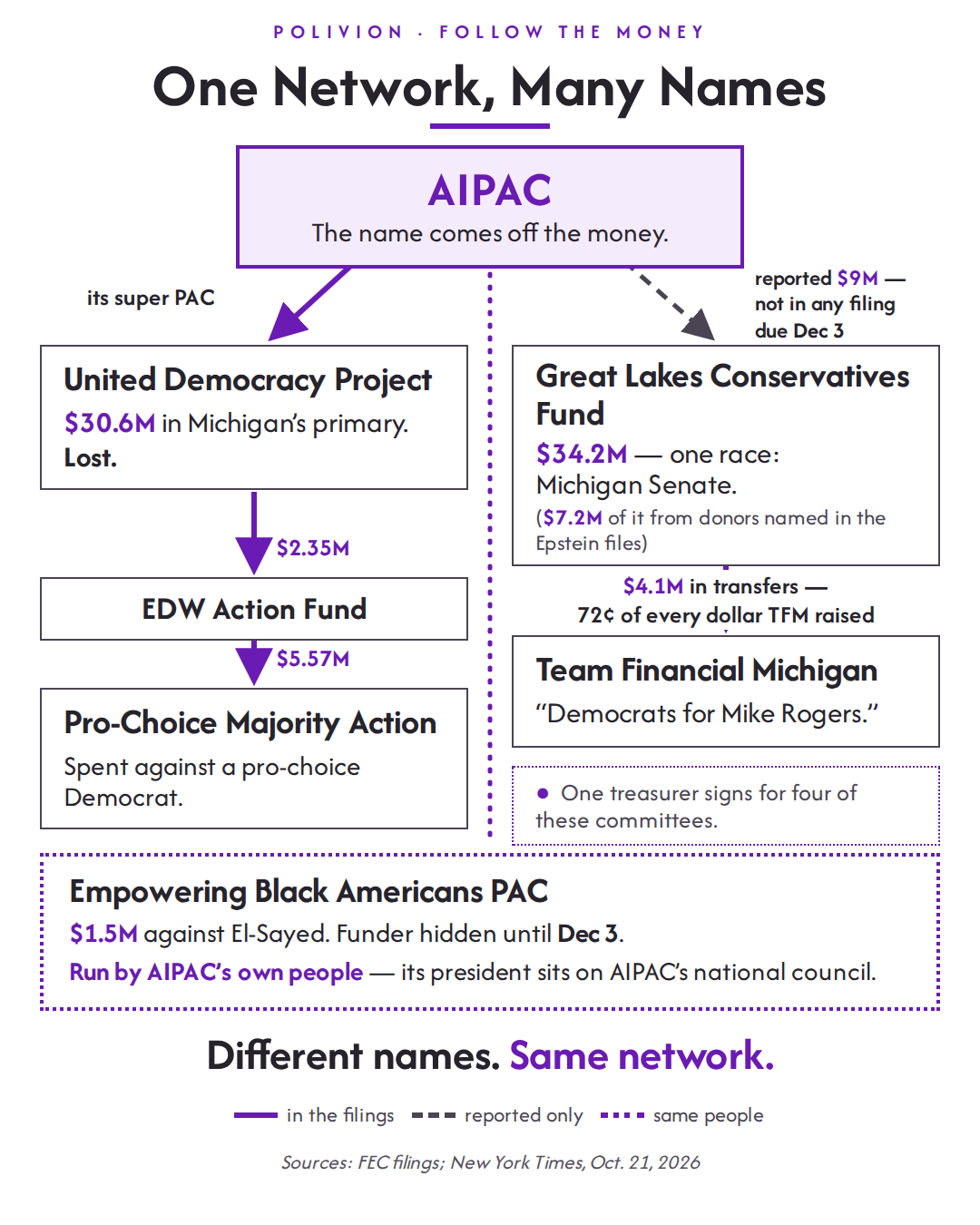
Michigan’s general election is that strategy at full size. The United Democracy Project spent $30.6 million trying to stop Abdul El-Sayed in the primary, and lost. The fight now runs through the Great Lakes Conservatives Fund — a super PAC whose name says nothing about Israel — which is spending $34.2 million to stop him in the general, every dollar of it in this one race. The branded vehicle is nearly invisible in it: UDP has spent just $64,393 directly supporting Republican Mike Rogers in the general. The two are reported to be connected — not documented: on October 21 — the same day the letter went out — the New York Times reported AIPAC planned to contribute as much as $9 million to GLCF, arriving after the October 14 close of books, and GLCF does not have to disclose its donors for that period until its post-general report on December 3, after the votes are counted: reported, not documented. An unbranded vehicle, money timed to surface after the election — the new approach, in one race.
Act one: the primary
The primary showed why the name had to come off. UDP spent $30,638,639 on Michigan’s Democratic Senate primary — $20,139,904 opposing El-Sayed and $10,498,735 supporting Haley Stevens — the largest single-race intervention in its history. It lost. El-Sayed won the August 4 nomination by less than a percentage point, after campaigning on AIPAC’s money. For the full cycle, UDP’s documented spending against him stands at $20,903,438 through October 29 — nearly all of it the primary.
Act two: the fund
The general-election vehicle does nothing else. GLCF’s independent expenditures total $34,188,901 — $19,557,130 opposing El-Sayed and $14,631,771 supporting Rogers — and no other candidate, in any race, appears in its spending; it exists for this race alone.
Through October 14, GLCF had taken in $25,879,139. Oil billionaire Tim Dunn seeded it with $5 million, and Robert Kraft — the Patriots owner whose name runs through the Epstein files — gave $100,000, after giving $3,500 to Stevens in the primary — one of nine GLCF donors named in the released Epstein files. Singer, Navarro, Penske and Chevron fill out the disclosed roll — but the disclosed roll is the smaller story; the timing is the larger: $12.1 million on its periodic reports through October 14; $34.2 million counting the late 24- and 48-hour notices. Roughly $22 million arrived in the final three weeks — funded substantially by money untraceable to any donor until December. Nor is the fund itself new to this candidate: GLCF spent against Elissa Slotkin in Rogers’ 2024 Senate race — the only other name in its spending, in any cycle — and Michigan has drawn this network’s money across cycles, the longer story PoliVion told in its Michigan case study. That is why some of the biggest checks in the table below are dated 2024: same fund, same candidate, two cycles, each gift labeled with its cycle. And 2024 is where the proof lives: it is the last cycle with full documentation. So much of this cycle’s money does not have to be documented until after the election that the pattern can only be shown whole in the cycle where every donor is already on paper.
The identified money, tallied — the nine donors named in the released Epstein files in the fund’s own filings, plus the one contribution that so far exists only in the Times’ reporting:
| Donor | Gave to GLCF | Cycle |
|---|---|---|
| Stephen Schwarzman | $4,500,000 | 2024 |
| Thomas Peterffy | $1,500,000 | 2024 |
| Steve Wynn | $1,000,000 | 2024 |
| Robert Kraft | $100,000 | 2026 |
| John W. Childs | $55,000 | 2026 |
| Marc Rowan | $25,000 | 2026 |
| Fred Ehrsam | $25,000 | 2024 |
| Casey Wasserman | $5,000 | 2026 |
| John Catsimatidis | $1,500 | 2026 |
| Subtotal — nine files-named donors | $7,211,500 | 2024: $7,025,000 · 2026: $186,500 |
| United Democracy Project — reported by the New York Times — REPORTED, NOT DOCUMENTED (arrived after the Oct 14 cutoff; in no filing until Dec 3) | $9,000,000 | — |
| Total identified | $16,211,500 |
The handoff
One check on the reported $9 million: GLCF’s pre-general report contains no contribution from UDP — consistent with the Times’ account of post-cutoff money, not proof of it. Until the post-election reports are filed on December 3, the figure stays reported, not documented.
The whole network, tallied — the documented independent spending against El-Sayed in this one race:
| Committee | Against El-Sayed | Window |
|---|---|---|
| United Democracy Project | $20,903,438 | Through Oct 29 |
| Great Lakes Conservatives Fund | $19,557,129.77 | Through Nov 2 |
| Team Financial Michigan | $11,293,187.41 | Notices through Oct 31 |
| Empowering Black Americans PAC | $1,538,000 | October 2026 |
| RJC Victory Fund | $1,354,388.42 | Oct 4–28 |
| Total | $54,646,143.60 |
Five committees. Every dollar of it aimed at one candidate in one state.
The side door
Its filed disbursements show three contributions to TFM, the super PAC behind the “Democrats for Mike Rogers” ads: $50,000 on September 25, $50,000 on October 1, and $4,000,000 on October 8 — $4.1 million in all. TFM had raised $5,718,641 through October 14 — about 72 cents of every dollar it had raised came from the Republican-side fund backing Rogers himself. Counting its late 24-hour notices, TFM has reported about $15.1 million in spending through October 31 — $11,293,187 opposing El-Sayed and $3,805,217 supporting Rogers — all in this race, under a Democratic banner; the late money’s source stays invisible until December 3.
“Independent,” but not at arm’s length from the candidate: Team Rogers, the joint fundraising committee built around Rogers’ campaign, transferred $332,114 to GLCF between last November and June. At an October 8 debate, asked whether he welcomed AIPAC’s public support, Rogers answered: “Anybody that wants to help my campaign... I’ll take all of that help.”
Our read
The thing being managed is the name. AIPAC’s network spent five years under its own flag, and the flag became the story: opponents ran against the endorsement itself, and in Michigan the branded super PAC’s $30.6 million lost to a man who made it his target — so the name came off.
This is not a claim about any donor’s motive. It is a claim about the behavior of AIPAC’s network, in its own filings and in AIPAC’s own letter: $30.6 million through one super PAC to stop a candidate in a primary; $34.2 million through another to stop him in the general — $4.1 million of it re-badged as “Democrats” for his opponent, a reported $9 million more invisible until the votes are counted. The target never moved. What changed is the visibility — and AIPAC’s network underneath is the constant.
And none of it started this year: the money has worked Michigan across cycles — what is new is that America is finally opening its eyes to it, just as the name comes off.
Five vehicles — United Democracy Project, Great Lakes Conservatives Fund, Team Financial Michigan, Empowering Black Americans PAC, and the RJC Victory Fund — and behind all of them, one source: AIPAC, and the network it built and steers.
Sources: FEC filings, GLCF, INC. (C00853861) — Schedule E independent expenditure records, 2026 cycle, through Nov 2, 2026; Form F3X reports through the Pre-General report (filed Oct 22, 2026), Schedule A receipts and Schedule B disbursements (GLCF→TFM contributions: Q3 report, transaction SB23.I2311, and Pre-General report, transactions SB23.I2323–I2324); FEC filings, United Democracy Project (C00799031), independent expenditures through Oct 29, 2026; FEC Schedule E records, TFM (C00960138), through Oct 31, 2026, and Empowering Black Americans PAC (C00882431), 2026 cycle; FEC Schedule E records, RJC Victory Fund (C00528554), Oct 4–28, 2026; AIPAC letter to members, Oct 21, 2026, as reported by Jewish Insider and CNBC (Oct 21, 2026); PoliVion, “The AIPAC Pivot” (/aipac-ends-endorsements/) and “The AIPAC Strategy” (/aipac-strategy/); The Intercept, “AIPAC Isn’t Retreating” (Oct 29, 2026) and “AIPAC Is Retreating From Endorsements and Election Spending” (Dec 30, 2025); New York Times AIPAC–GLCF reporting, Oct 21, 2026 (reported, not documented); Front Office Sports, “Michigan Senate Race: At Least 10 Sports Owners Backed Mike Rogers,” Nov 2, 2026; Daily Caller, “Mike Rogers Now Says He Welcomes AIPAC Support,” Oct 9, 2026; PoliVion Michigan case study and “It’s Not Red or Blue. It’s You-Know-Who.” (Nov 1, 2026).
The race this money is deciding
Five committees — UDP, GLCF, TFM, EBAP and the RJC Victory Fund — have spent a combined $54.6 million against one candidate in one state. Michigan votes Tuesday.
The Michigan Senate race → The United Democracy Project → ← Back to the dashboard