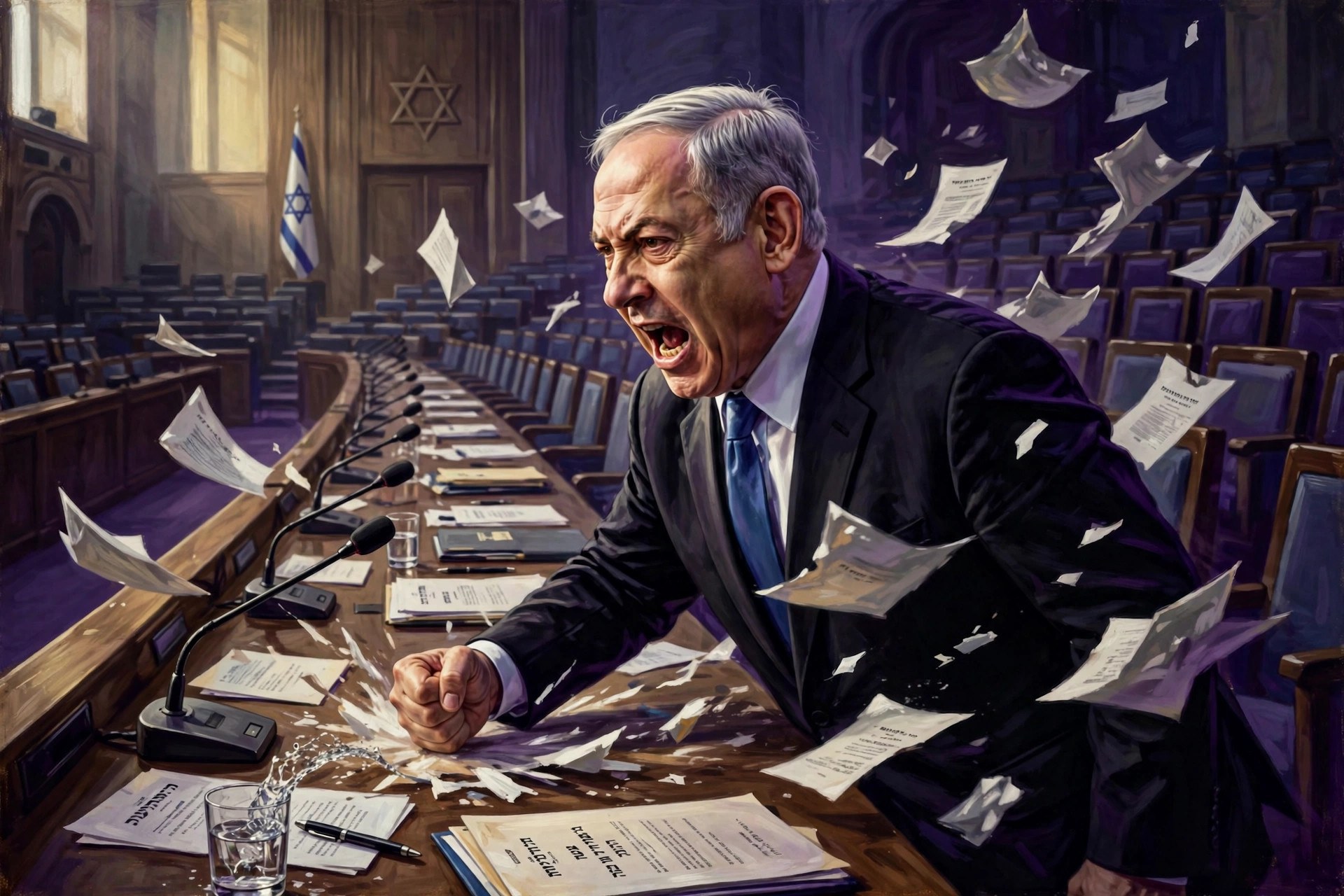
So, is it forbidden? No. There is no such rule. There never has been. And the man saying it loudest tried to form exactly that government himself, five years ago.
What the law actually says
Israel’s Basic Laws say how a government is made. The President asks one lawmaker to try. That lawmaker builds a team. The Knesset votes. Under Basic Law: The Government, “the Government holds office by virtue of the confidence of the Knesset.”
The vote needs a majority of votes cast — not a fixed 61; if opponents abstain instead of voting no, a government can lawfully be sworn in with fewer. Seats are dealt by votes alone; the law draws no line between a Jewish vote and an Arab one.
There is exactly one legal tool for keeping a party out: Section 7A of Basic Law: The Knesset. It lets the elections committee bar a list that denies Israel’s existence as a Jewish and democratic state, incites racism, or supports armed struggle against it — subject to the Supreme Court, which reads the bar narrowly.
That tool was used this year — against the Arab lists. On September 23, 2026, the committee voted 18–5 to bar Ra’am and 18–5 to bar the Joint List; the Attorney General’s office opposed the bans as below the legal threshold. On October 2, the Supreme Court overturned them. Both lists ran, won, and hold 19 seats as lawful as any in the building.
Political analyst Ahmed Najar put the legal position in one line this month: “The obstacle is, therefore, neither constitutional nor practical but ideological.”
He tried it himself
In 2021, Israel voted for the fourth time in two years. Likud won 30 seats; Netanyahu’s bloc reached 52 — short. The four seats that decided everything belonged to Ra’am, the Islamist party led by Mansour Abbas.
Before that election, Netanyahu had repeatedly ruled out relying on Ra’am, calling the party anti-Zionist. His party was simultaneously courting Arab voters — campaigning in Arabic under the name “Abu Yair.”
Then the seats were counted, and he needed Abbas. His Likud emissaries reached out anyway. It became a real negotiation over Ra’am’s price: major budgets for Arab education, infrastructure and crime-fighting, and a say in how the money was spent. On April 1, Abbas made his pitch live, in Hebrew and Arabic: “What we have in common is greater than what divides us.”
What killed it was not a law, and not Netanyahu’s principle. It was Bezalel Smotrich, whose party held seats he needed. On March 25, 2021, Smotrich said it in one sentence: “There will be no right-wing government based on Mansour Abbas’s Ra’am party. Period.” Netanyahu pressed his camp, including through Rabbi Chaim Druckman; Smotrich did not move, and on May 4 Netanyahu handed the mandate back.
The Washington Post’s Good Authority summed up that spring: “Netanyahu and his party members worked hard to legitimize the Islamist party as a coalition partner.” No statement by Netanyahu himself calling Ra’am legitimate exists on the record — his legitimization of Abbas was done through emissaries, negotiations, and a price list.
And then it happened anyway
The mandate passed to Netanyahu’s opponents — and they did the thing he had just tried to do.
On June 2, 2021, Ra’am signed on as a full partner — not outside support, a seat inside the coalition — in the Bennett–Lapid government. On June 13, the Knesset approved that government 60–59, with one Ra’am lawmaker abstaining. For the first time in Israel’s history, an independent Arab party sat inside a governing coalition — sworn in under the same Basic Laws Netanyahu now says forbid it.
Abbas won real things for his voters: a package reported at more than NIS 53 billion, including a NIS 30 billion five-year development plan for Arab society, money against the crime epidemic in Arab towns, and legalization of three unrecognized Bedouin villages in the Negev.
The government worked about a year before falling apart, and stayed in office until December 29, 2022 — replaced by Netanyahu’s next government, with Smotrich and Ben Gvir — the two men who vetoed the Ra’am route — in the cabinet.
It goes back further
2021 was not even the first time. Thirty years earlier, Arab lawmakers kept a government alive through the Oslo peace process.
Yitzhak Rabin’s coalition began with 62 seats. In September 1993, the religious party Shas walked out, leaving him with 56 — a minority, held up from outside by two Arab parties, Hadash and the Arab Democratic Party. On September 23, 1993, a no-confidence motion tied to the first Oslo accord was defeated 61–50; the five Arab lawmakers voting with the government were decisive. On October 6, 1995, the Knesset ratified the Oslo II agreement 61–59, with Arab votes inside the 61.
The right’s answer then is the ancestor of “forbidden” now: the claim that Oslo had no “Jewish majority.” It was an argument, not a law. The votes counted. The accords were ratified. The government stood.
The warnings
There is one more part of the record, and it is the part that makes the word “forbidden” hardest to hear. PoliVion told the full October 7 story in our election-day report. Before the attack, warnings reached his government from his own intelligence services — and, on the documented record, from Arab governments.
Egypt
Egyptian officials say Cairo warned Israel repeatedly that “something big” was planned in Gaza. On October 11, 2023, Michael McCaul, the Republican chairman of the House Foreign Affairs Committee, said it on the record after a classified briefing: “We know that Egypt had warned the Israelis three days prior that an event like this could happen.” The Atlantic reported this September that Egypt’s intelligence chief, Abbas Kamel, secretly flew to Israel on September 26, 2023 — a flight confirmed by flight-tracking data — to warn that Hamas was mobilizing. A former Israeli official briefed on the visit summed up the message as: “If you don’t change course, Gaza is going to blow up in your faces.”
Netanyahu’s office denies all of it — no message ever reached him, it says — and he has called the warning claims “totally fake news.” Egypt’s own record is not uniform either — an Egyptian official denied the warning in October 2023, and this week KAN News reported the passengers on that flight were two businessmen, not Kamel. The dispute is real; the McCaul statement is on the public record either way.
The Emirates
Haaretz reported this September that UAE President Mohamed bin Zayed called Netanyahu about a week and a half before October 7, spoke for 45 minutes, and warned him Hamas was planning a major operation. The New York Times corroborated the call through two sources, and reported that Netanyahu never mentioned it at an October 1, 2023 meeting with his security chiefs, in minutes the paper reviewed. Netanyahu calls the account “an absolute lie” and has sued over it. The UAE government has declined to confirm or deny the call.
His own services
Israel’s intelligence had the attack plan itself. The New York Times reported in November 2023 that Israel had obtained Hamas’s battle plan — a roughly 40-page document code-named “Jericho Wall,” describing the invasion point by point — more than a year before the attack, and dismissed it as a plan Hamas could not yet carry out. In July 2023, a veteran Unit 8200 analyst watched Hamas rehearse that plan and wrote to her superiors: “I utterly refute that the scenario is imaginary.” A Gaza Division colonel called it “totally imaginative” and brushed it off.
The festival
The Nova festival was moved, two days before it opened, to a clearing near Kibbutz Re’im, about three miles from the Gaza fence, and extended a day with the army’s approval. The army’s own probe, released in April 2025, found that the IDF assigned the festival nothing: no troops to guard it, no police coordination, no liaison officer — and most forces in the sector never knew it was taking place. The probe’s conclusion was three words: “the IDF failed.” A brigade commander who had signed the approval visited at 5:30 that morning, saw 4,000-plus people and a thin police presence, and decided not to reinforce or clear it. 378 people were murdered at the festival, and 44 were taken hostage.
The morning
Even the hour he woke up is disputed: his office’s schedule says 6:29 a.m., the minute the attack began; Avi Gil, his military secretary — who took the night’s warning calls and chose not to wake him — now says it was 6:40, and that transcripts were altered to read 6:29.
Why he says it now
Now look at the count. Netanyahu’s bloc: 53 seats. The opposition: 48. The Arab parties: 19 — the most they have ever won. Nobody has 61. As our scenarios piece lays out, every path from here runs through those 19 seats.
That is what the word is for. It is not aimed at the law, which does not contain it. It is aimed at Gadi Eisenkot — the man best placed to replace Netanyahu, whose only road to a government runs through Arab support. Declare that road illegitimate in advance, and 53 gets to call itself the majority — the majority of the votes Netanyahu chooses to count.
Others have answered him. Sami Abu Shehadeh of the Joint List: “If we were a normal, democratic, non-racist country, Netanyahu would have lost the elections.” Yair Golan of the Democrats: “I know how to count to 120. 65 is more than 55. That’s how Israeli democracy works. Period.” And Abbas, whose phone is ringing from both camps, said on election night: “Everyone is speaking with us.”
To be fair to the record, the taboo is not Netanyahu’s alone. Eisenkot ruled out building a government on Arab votes during the campaign, and Bennett says he wants only Zionist partners. But neither of them calls it forbidden. Only the man who tried it calls it that.
Our read
This section is PoliVion’s analysis — our reading of what the facts mean, labeled as analysis, not news.
A rule that applies only to your opponents is not a rule. In 2021, a government resting on Ra’am was legitimate enough for Netanyahu to negotiate for, with emissaries and a price list, until his own partner vetoed it. In 2026, the same arrangement is “forbidden” — because this time it would save the other side. The word does a job: it shrinks the electorate until 53 looks like a majority, and it tells a fifth of Israel’s citizens that their votes count for less. And the side he now calls illegitimate is the Arab side — the side the warnings came from, while the failures that left a battle plan in a drawer and a festival unguarded belong to the government of the man inventing the rule. Forbidden, it turns out, is just the word for something Netanyahu is not allowed to lose to.
Sources: The Times; ANI; Law Library of Congress; Al Jazeera; Jewish News; Times of Israel; Press Trust of India; Good Authority (Washington Post); Deb Amos; The Media Line; Associated Press; The Atlantic; Haaretz; Le Monde; The New York Times; All Israel News; KAN News.
Why this is on PoliVion
PoliVion tracks the pro-Israel money network in America’s elections. The government that network sustains is now arguing that a fifth of its own country’s votes should not count toward forming a government.
See the network map → ← Back to the dashboard