The joke
On the morning of Sunday, November 8, the Israeli government’s official account on X posted a single sentence: “Contrary to popular belief, Israel does not control the weather.”
It was posted on the Sunday morning after the first winter storm of the season flooded the tent camps of Gaza — while the water was still standing in the camps, and hours before a rain-loosened embankment collapsed onto tents south of Deir al-Balah that night, killing a woman and three children by Reuters’ count, five people by Gaza Civil Defence’s. The post has been viewed more than four million times. No official explanation of what prompted it has been reported.
AJ+ answered it the next day: “Israel does not control the weather — but here’s what it does control.” The list was shelter, aid, and the means of repair. That list is the subject of this article, because everything on it is documented.
Fifty years of trying to make rain
Weather modification is not a fantasy Israel’s critics invented. In Israel, it was a department, a budget, and a fleet of aircraft.
Israel’s randomized cloud-seeding experiments began in 1961. The first, Israel-1 (1961–67), reported a 15% increase in rainfall; Israel-2 (1969–75), over the Lake Kinneret basin, reported 13%. On the strength of those results, operational seeding ran in northern Israel from 1975 to 2013 — 38 years — directed by the Rain Enhancement Branch of Mekorot, the national water company, financed by the Israel Water Authority, dispersing silver iodide over the Kinneret watershed.
The results the world was told were not the full results Israel had. Israel-2’s celebrated 13% came from its northern target alone. The experiment’s southern target, seeded on the crossover days, suggested rainfall had decreased by some 15% — and the full crossover evaluation of Israel-2, which came out at roughly zero, was not published until 1990, fifteen years after the experiment ended. When independent scientists re-analyzed both landmark experiments in 1995, Arthur Rangno and Peter Hobbs of the University of Washington concluded that Israel-1’s apparent increase was a statistical mirage — “lucky draws,” a Type I error — and that similar rainfall increases had occurred over unseeded Lebanon and Syria. In 2006, an independent panel of Israeli experts reviewing more than thirty years of operational seeding found no evidence rain had been increased at all. The fight in the journals is not over: Daniel Rosenfeld, Israel’s leading seeding proponent, and his colleagues dispute the critics’ methods to this day. But the pattern in the publication record is a fact independent of who is right: the triumphant numbers were announced at once; the numbers that undermined them took fifteen years to print, and when the establishment published its own retrospective in 2023, Rangno charged in writing that it omitted the literature that overturned the first two experiments “and thus misled readers.”
The claimed effect shrank as the measurements improved. Re-analyses in 1995 and 2010 concluded the early increases were natural rainfall patterns mistaken for seeding results. The final experiment, Israel-4 (2013–2020), was stopped a year early: it measured a 1.8% increase, statistically indistinguishable from zero. In 2021, the Water Authority ended the program.
That ending matters, and this article will not pretend otherwise: Israel’s own best science says seeding barely did anything, and the state stopped paying for it. What the record also says is that for five decades, the Israeli state wanted rain on demand badly enough to fund the attempt as national policy.
What the science allows
What seeding needs, in the science’s own terms, is specific: a cloud carrying supercooled water — droplets still liquid below freezing — in the band where silver iodide works, roughly −5° to −25°, coldest-effective around −10° to −20°. Too warm and there is nothing to freeze; too cold and the cloud has frozen itself. A mid-temperature cloud still holding its water is the ideal target. Winter storms are made of such clouds. That is the entire technical premise of every seeding program ever run, including Israel’s fifty years of studying the winter clouds of this exact coastline.
Nor is seeding imaginary. In 2017, the SNOWIE experiment in Idaho produced the first unambiguous physical proof of the whole chain — silver iodide released into winter mountain clouds, ice crystals forming, snow reaching the ground that would not have fallen otherwise. The practice is commercial: ski resorts and water agencies pay for it across nine western U.S. states. Winter Park Resort in Colorado seeds the clouds upwind of its slopes; the Desert Research Institute, which runs its generators, estimated the 2023 seeding added roughly 24 inches of snow — about 13% on top of what fell naturally. Wyoming’s pilot program measured 5–15% increases in mountain snowfall. In the right clouds, seeding demonstrably adds precipitation. That is proven, and this article says so plainly.
The right clouds are the whole qualification. The proven case is winter snow over mountains, in modest amounts. The World Meteorological Organization’s current statement is blunt: “it is impossible to create cloud systems that rain, alter wind patterns to bring water vapour into a region, or eliminate severe weather phenomena,” and “there are no demonstrated methods to modify… floods… by cloud seeding.” A U.S. Government Accountability Office review (December 2024) put estimated seeding effects at 0–20% additional precipitation — only from clouds that already exist and are already suitable.
Governments have, once, documentedly tried to use rain as a weapon. It was the United States: Operation Popeye (1967–72) seeded clouds to extend the monsoon over the Ho Chi Minh trail in Vietnam. The exposure of Popeye produced the ENMOD Convention, which bans hostile environmental modification. No documented case exists of Israel using seeding as a weapon, and no evidence connects any seeding to the storm that hit Gaza: a Mediterranean winter front over a flat coastline is not the mountain snow-cloud seeding is proven in, Israel’s own clouds were found to be among the poorest seeding targets anywhere — already full of natural ice — and Israel’s program has not operated since 2021.
Those are the limits of the record, printed here because they are the record.
The flood
The storm that arrived overnight on November 6–7 was, meteorologically, an ordinary first winter storm. What it landed on was not ordinary.
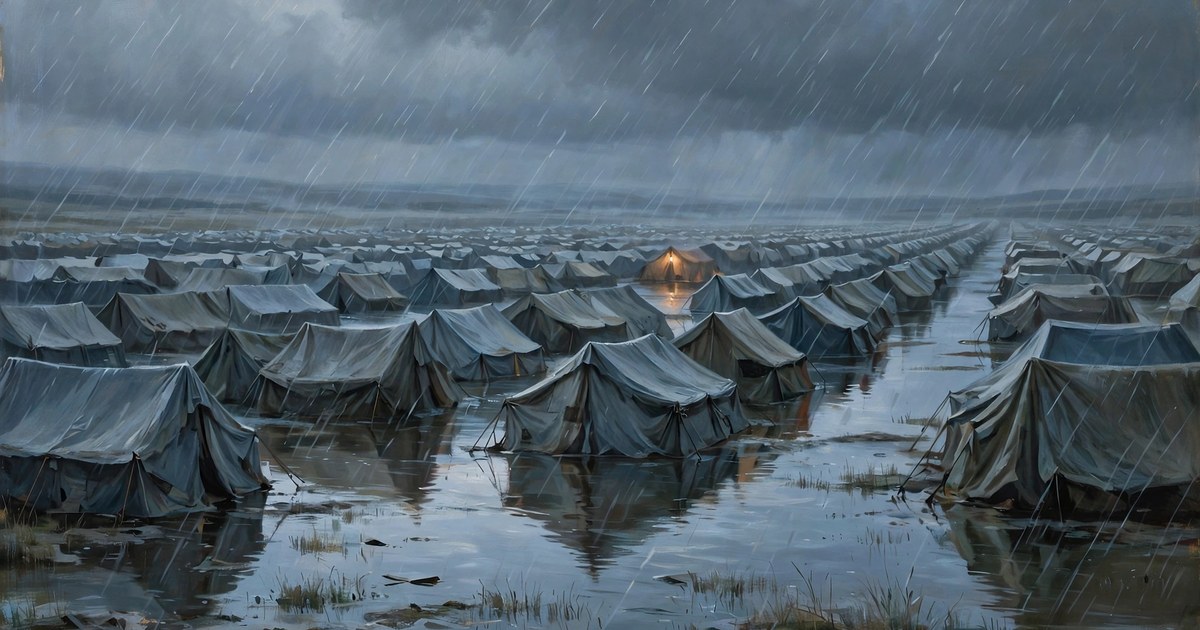
Gaza’s Government Media Office said at least 70,000 tents were flooded in 12 hours; Reuters and the BBC independently described tens of thousands. Gaza’s Civil Defence reported water 30–40 centimeters deep inside shelter sites and, in a later tally, 2,166 distress calls of which only 218 could be answered. UN OCHA said more than 26,000 households reported damage to shelters or belongings. On the night of November 8, rain washed a sand embankment onto tents south of Deir al-Balah: Reuters reported four killed, a woman and three children; Gaza’s Civil Defence reported five, two women and three children. Both figures are printed because both are the record.
Roughly 1.2 million people in Gaza — 58% of the population, including more than 560,000 children — were assessed by the Palestine Shelter Cluster as living in critical or catastrophic shelter conditions before the storm, with Gaza’s drainage and sewage networks destroyed and pumping stations down. An ordinary storm does not need help to flood a population living in tents on broken drainage. It only needs the tents, the ruins, and the closed crossings to still be there when winter comes.
Disaster money, conditioned
Weather is not the only place this alliance treats disaster as a lever. This year, the United States government wrote Israel into the terms of American disaster money.
In April 2025, the Department of Homeland Security’s standard grant terms defined a prohibited “discriminatory boycott” as cutting commercial relations “specifically with Israeli companies or with companies doing business in or with Israel.” On August 1, 2025, FEMA grant notices applied those terms to at least $1.9 billion in disaster-preparedness funding — search-and-rescue equipment, emergency-manager salaries, backup power — as Reuters reported on August 4.
The same day Reuters published, DHS removed the Israel language. A spokeswoman said FEMA grants are “not political litmus tests,” and DHS stated that no state lost funding. Both statements are accurate as far as they go: the condition was imposed on paper and withdrawn within a day, under backlash that came loudest from the administration’s own base. What survived the withdrawal was the generic ban on “discriminatory” boycotts in DHS’s terms — the word “Israel” removed, the mechanism left standing. CAIR called the condition “dangerous and unconstitutional.”
So the precise record is this: the administration tried to condition Americans’ disaster preparedness money on their stance toward Israeli companies, and stopped within hours — not before the attempt was documented, by Reuters, in the government’s own grant notices.
Our read
The official account’s joke only works if the premise is absurd — if no serious state would ever treat weather and disaster as instruments. The documented record says the opposite. Israel spent fifty years and public money trying to summon rain. The United States once ran rain as a weapon of war, and the world wrote a treaty about it. And in 2025, the United States government reached for disaster money itself as an instrument of loyalty to Israel, and let go only when its own supporters revolted and the constitutional problem had a name. Nothing in that sequence is a change of heart. It is a lever being set down because it could not be held.
Nobody needed to seed the clouds over Gaza. The rain was coming either way; it comes every winter. What was decided — by named governments, in documents anyone can read — is what the rain would fall on: a population kept in tents for a fourth winter, its drainage destroyed, its shelter stock a fraction of its need, its crossings controlled by the same state that jokes about the weather. Control was never in the sky. It is in the crossings, the aid lists, the grant terms, and the reconstruction that does not begin. One question the record leaves open, and this article poses it without answering it: Israel studied the seeding of winter clouds over this coastline for fifty years. The conditions the science names — mid-temperature clouds holding supercooled water — are the conditions a winter storm brings. The storm came, to their adversary, living in tents. And the Israeli state’s public word on the subject, delivered while the water was still rising, was a joke about controlling the weather. No document shows any seeding took place that week, and none is claimed here. But a state does not get to spend five decades on a science, watch its textbook conditions arrive over an enemy it keeps in tents, mock the very idea mid-disaster — and call the question absurd.
The weather is the one thing in this story nobody controls. Everything else is.
Sources: Rangno, review of Benjamini et al. and “The Rise and Fall of Cloud Seeding in Israel,” University of Washington Cloud & Aerosol Research Group; Rangno & Hobbs (1995); Levin, Halfon & Alpert, Atmospheric Research 97 (2010); Gabriel & Rosenfeld (1990); Benjamini et al., “The Israel 4 Cloud Seeding Experiment,” Journal of Applied Meteorology and Climatology, March 2023; WMO Statement on Weather Modification (June 2025); U.S. GAO, Cloud Seeding Technology, GAO-25-107328, December 2024; French et al., SNOWIE, PNAS, 2018; Bloomberg News (via Phys.org), February 2026; Wyoming Weather Modification Pilot Project; Globes, February 1, 2021; Calcalist, January 28, 2021; Reuters, August 4, 2025 and November 7–9, 2026; BBC News, November 7, 2026; UN OCHA, November 2026; New York Times, August 4, 2025; Newsweek, August 4, 2025; Jewish Currents, 2025. Figures attributed in text where outlets differ.
Why this is on PoliVion
PoliVion follows the money and the paper behind American politics. This article sits where the two meet: a foreign government’s joke about the weather, fifty years of documented rain-making, and an American disaster-aid condition that was imposed on paper and withdrawn within a day.
The People’s Intent → All PoliVion articles → ← Back to the dashboard