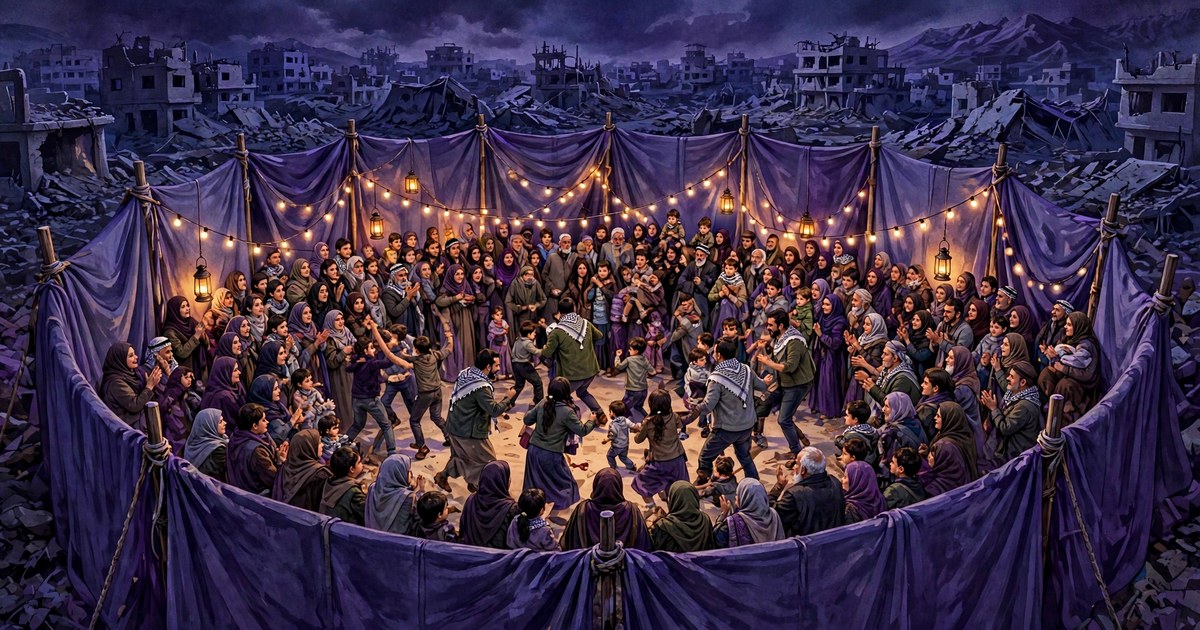
The video is real, and that is exactly why it is worth slowing down for. On November 20–21, a Gaza City event company, Al-Dawla Media, filmed the men’s launch party for a groom named Muhammad Abu Asous — hundreds of men dancing the dabke under a canopy of string lights and paper stars, a singer on a stage, flame canisters firing into the night. Within a day, the footage was everywhere, carrying a caption it never had at the wedding: proof, its posters said, that Gaza is fine.
The claim built on it is specific, so it can be checked. The account RadioGenoa posted the clip on November 22 as “This is Gaza. November 2026. Super party. Super wedding.” The actor Dean Cain quote-posted a montage account at 1:42 in the morning with a sarcastic “Stop the genocide!” The argument, stated plainly by dozens of accounts since: a population being starved and exterminated could not produce clean clothes, fresh haircuts, working speakers, and a party. Therefore, they say, there is no genocide and no famine.
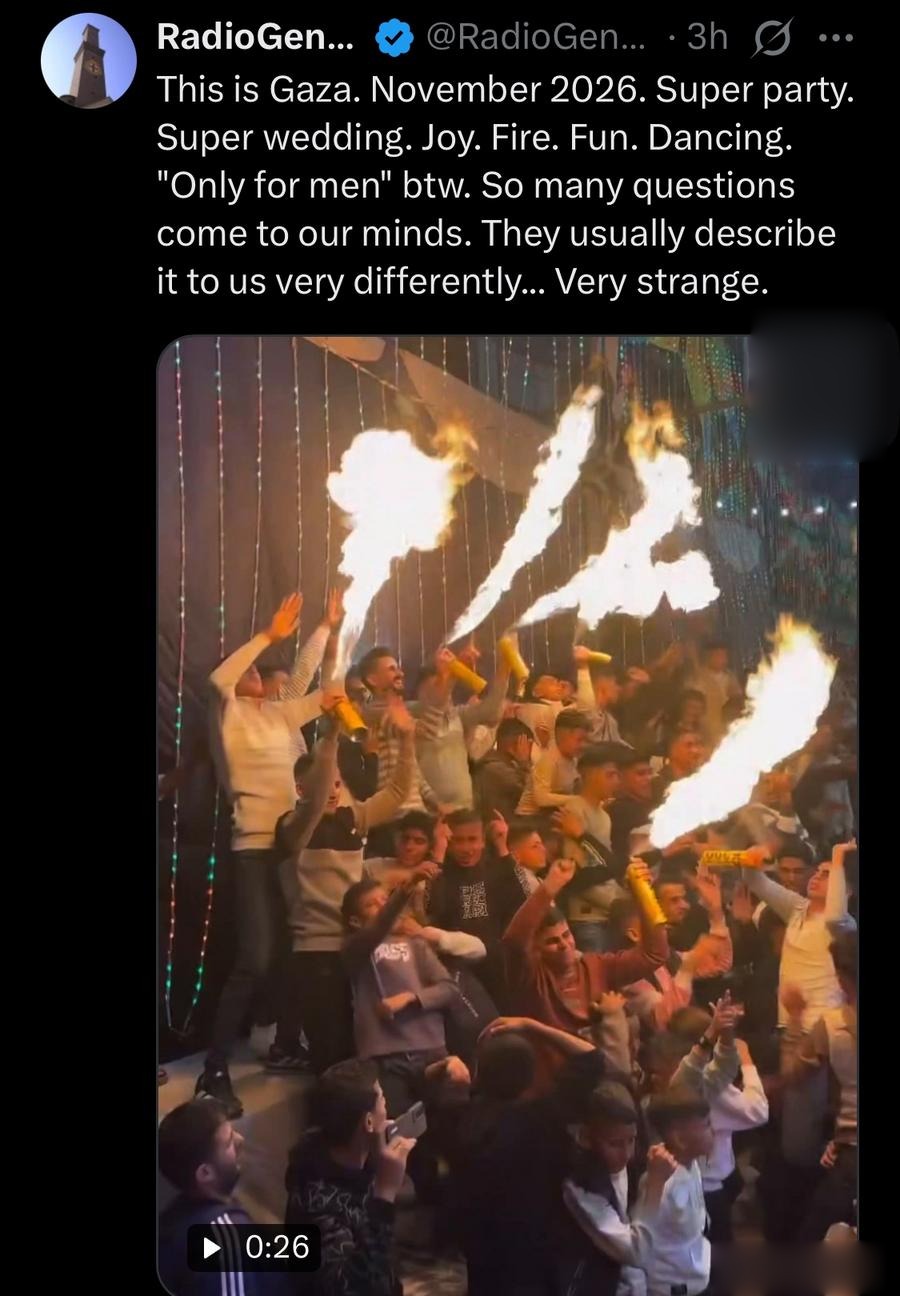
Start with what is verified about the clip itself — because the honest answer helps no one’s shortcut. The footage is recent and it is from Gaza City: the photographer’s own posts (Mohammed Al-Zaabout, November 20–21) and the event company’s watermark establish that. The groom, the two families — Abu Asous and Al-Deiri — and the date are documented. No Reuters, AFP, AP or Snopes fact-check of this specific clip exists as of November 22. What the wedding was is not in dispute. Everything built on top of it is.
One detail spreading with the clip is not verified at all. The claim that the party was held in Gaza City’s Sabra neighbourhood traces to a single source: a reply by Grok, the platform’s AI chatbot, in the repost threads. AFP has documented Grok mislocating Gaza images before. The city is verified. The neighbourhood is a chatbot’s guess, repeated until it read like a fact.
It isn’t one event
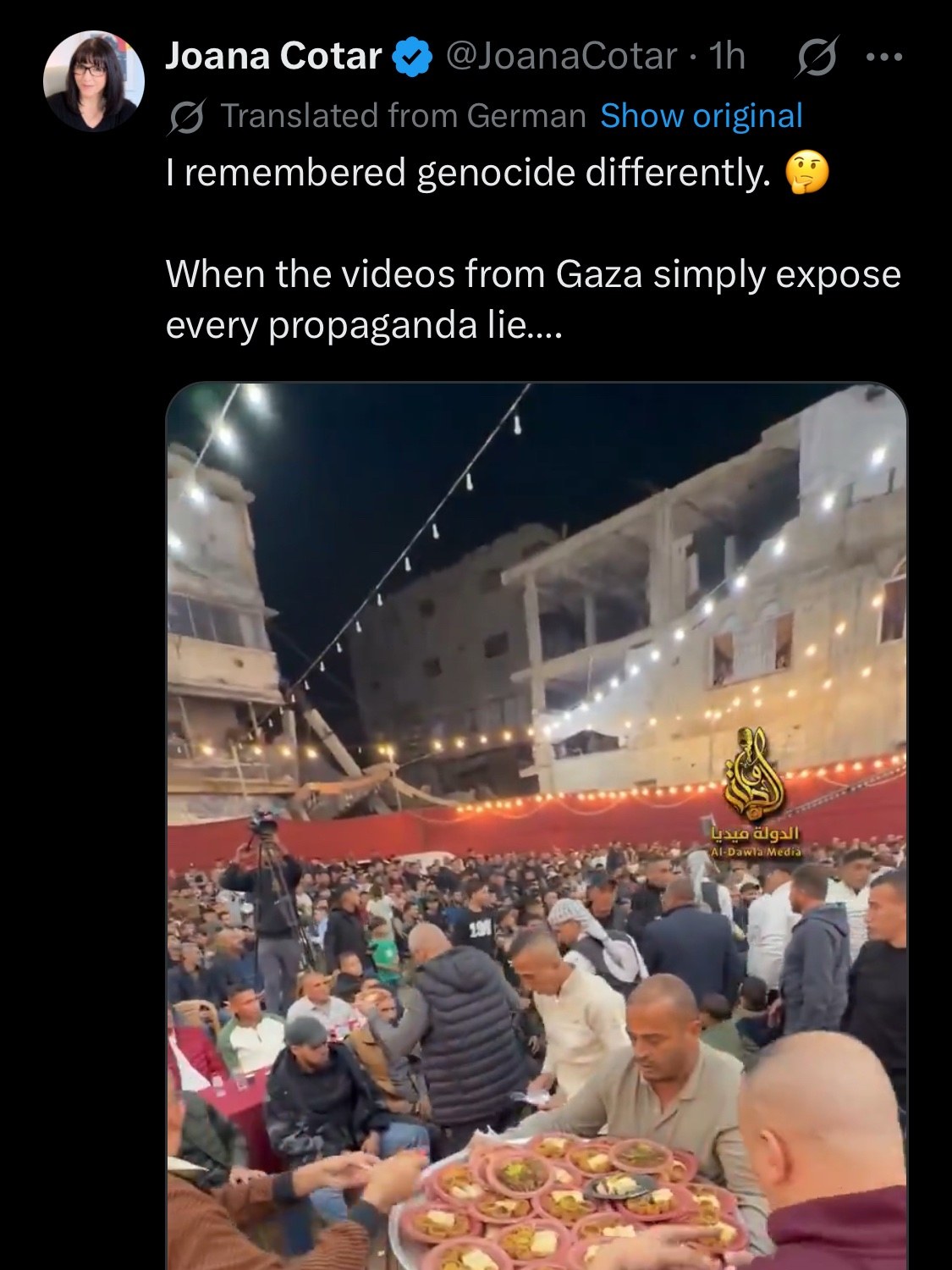
Look at the backdrops, because they change — and backdrops don’t change at a single party. The Abu Asous footage was shot under a canopy of string lights and hanging stars. Other clips in the same viral stream face a stage of tall, LED-lit pillars under red spotlights. Another shows a singer before a full-height LED video wall. A fourth, posted by the German politician Joana Cotar, shows food trays carried past a long red fabric wall, with bombed-out buildings directly behind it. These are different rigs, in different places, on different nights.
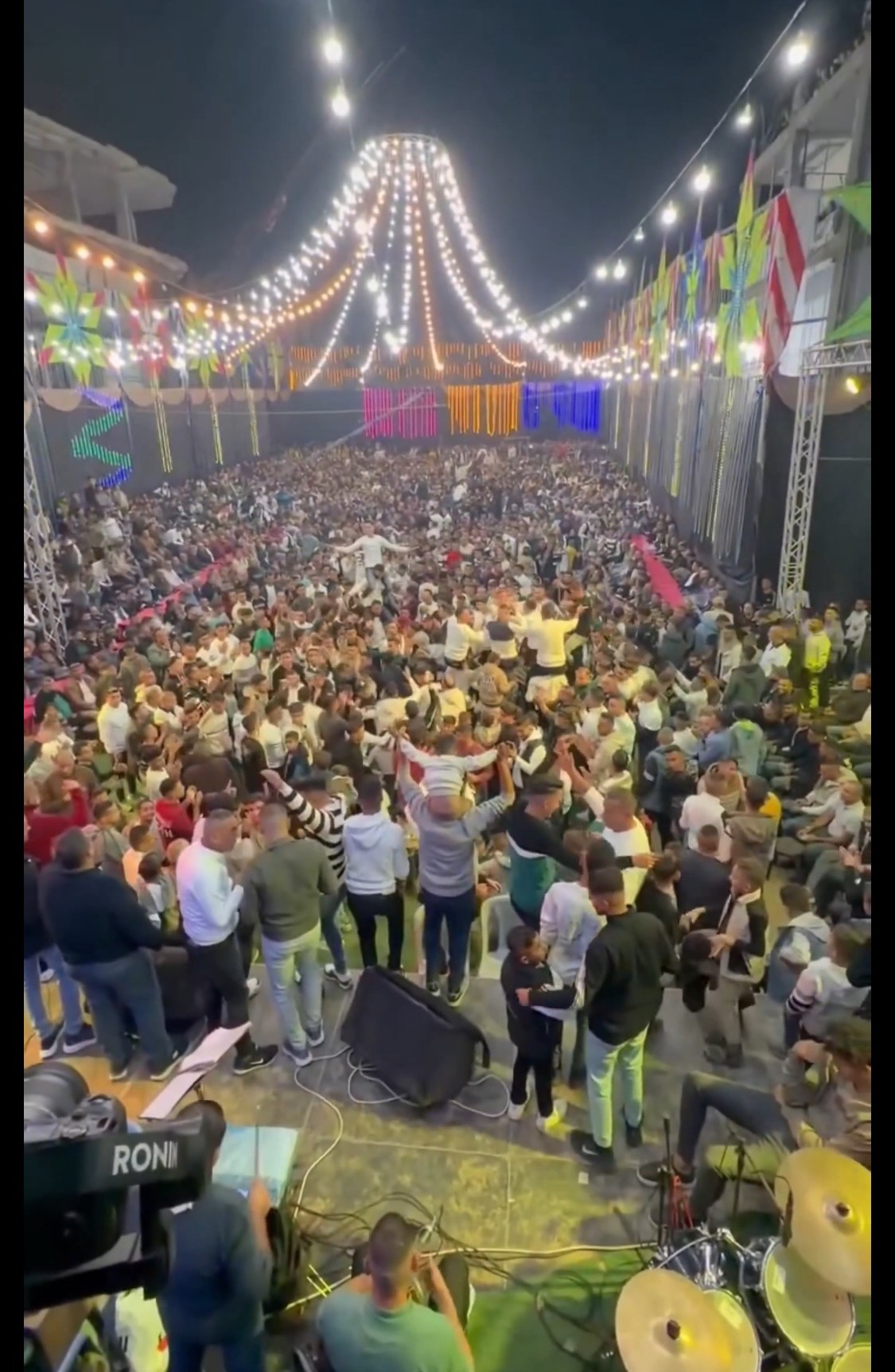

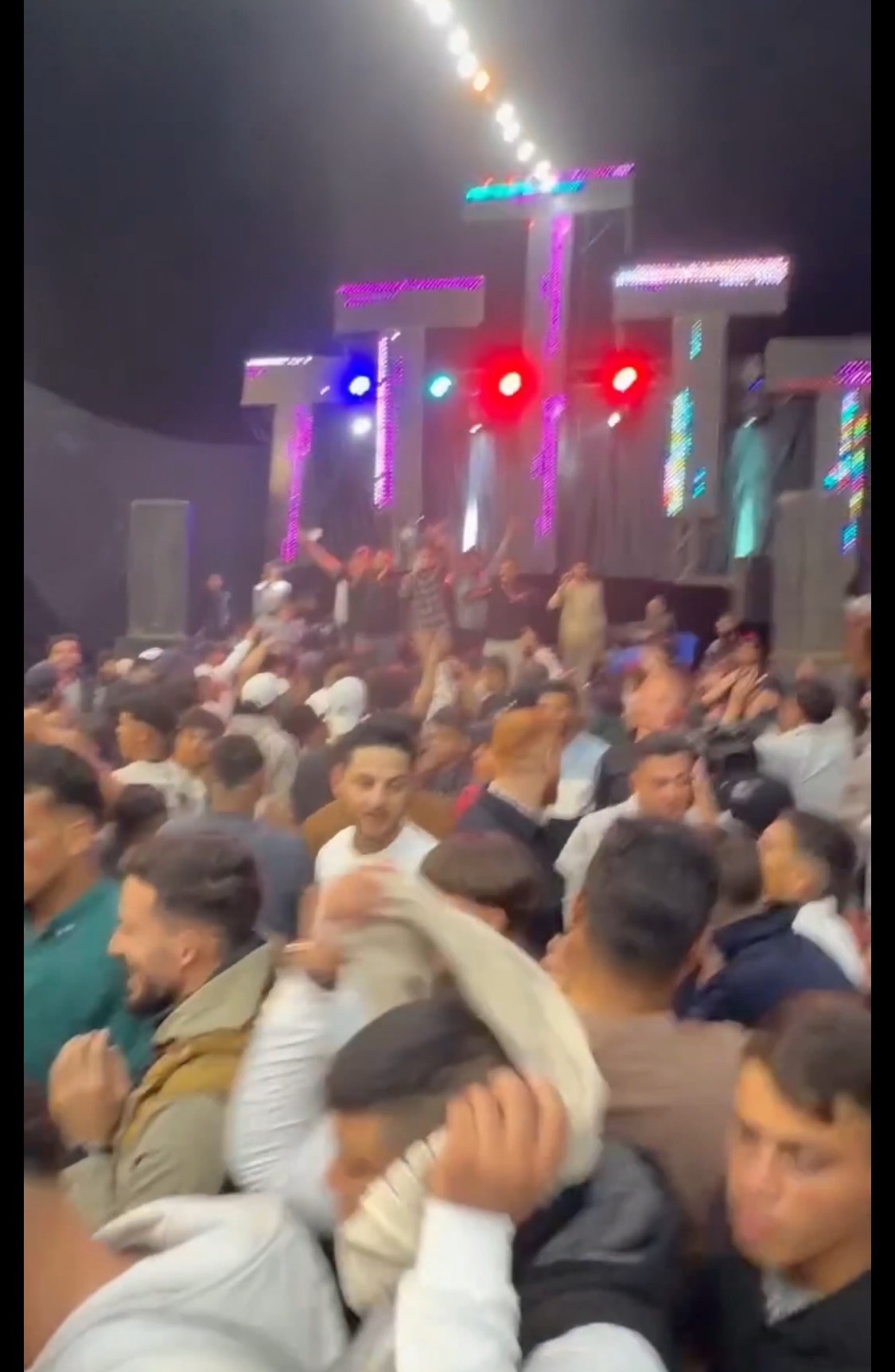
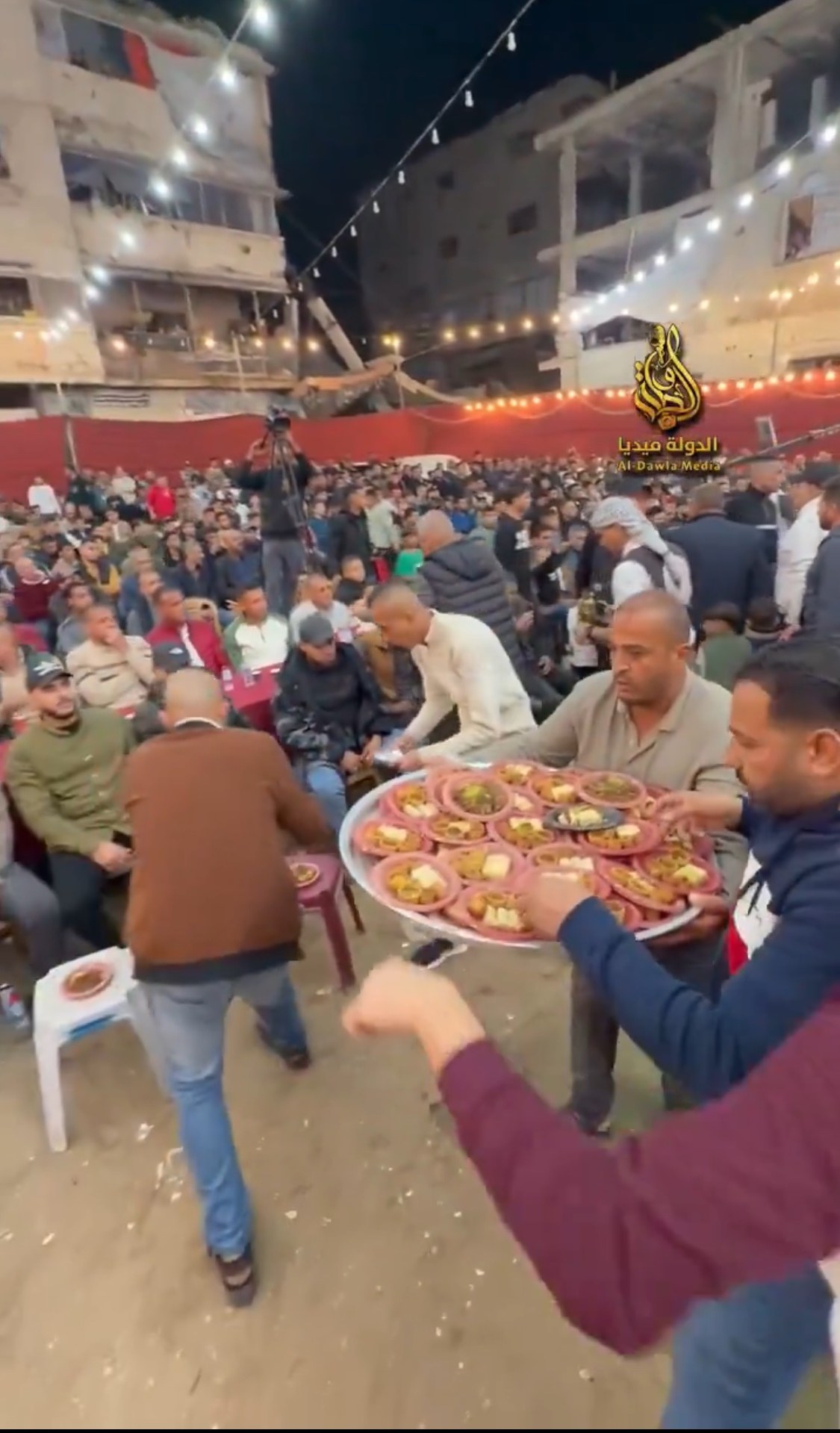
The posters say so themselves. RadioGenoa’s follow-up post, less than an hour after the first, reads: “Another huge party in Gaza. November 2026. One party every day.” Another. The stream is a montage — several real weddings and celebrations, filmed across at least two weeks, cut together and received by viewers as one continuous picture of “Gaza right now.”
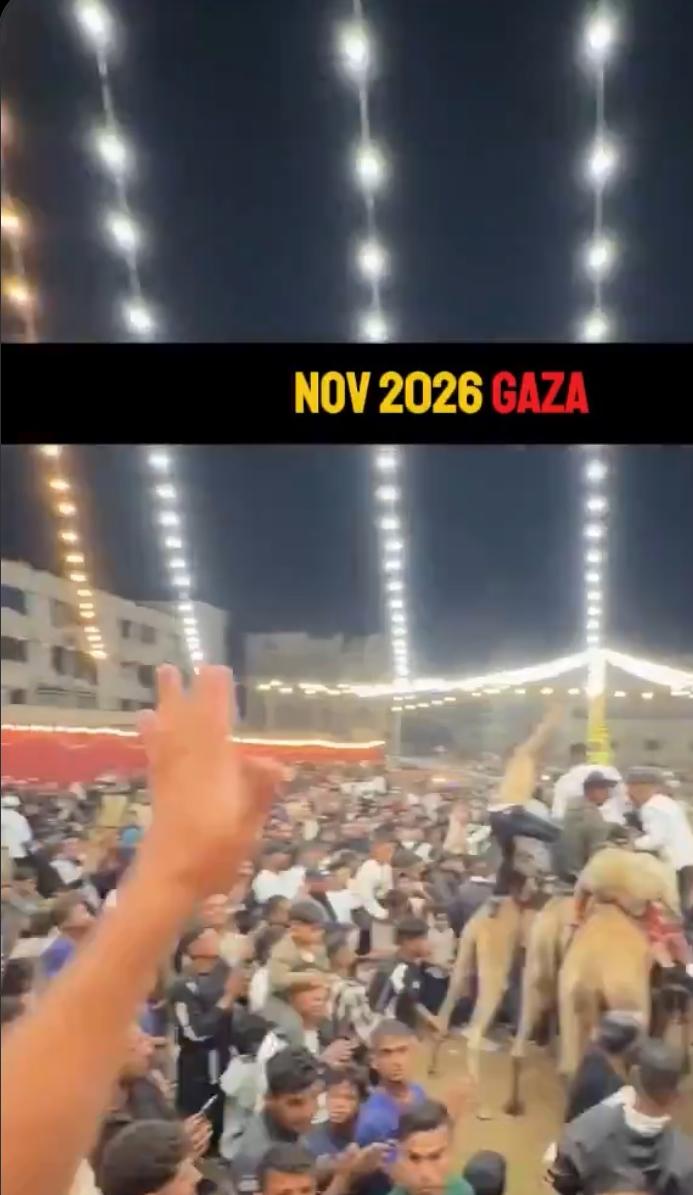
The montage absorbs footage that isn’t from Gaza at all. GAZAWOOD — an account built on the “Pallywood” framing that Palestinian suffering is staged — circulates a montage stamped “NOV 2026 GAZA” that includes camels moving through a wedding crowd. The only camel-wedding story on record from this period is not in Gaza: it is a wedding in Hebron, in the West Bank, where Israeli police arrested four Palestinians, including the groom, after a clip showed men forcing an energy drink into a camel’s mouth (TPS-IL, November 11). No source places camels at the Abu Asous wedding. Once a clip is inside the montage, its label does the lying for it.
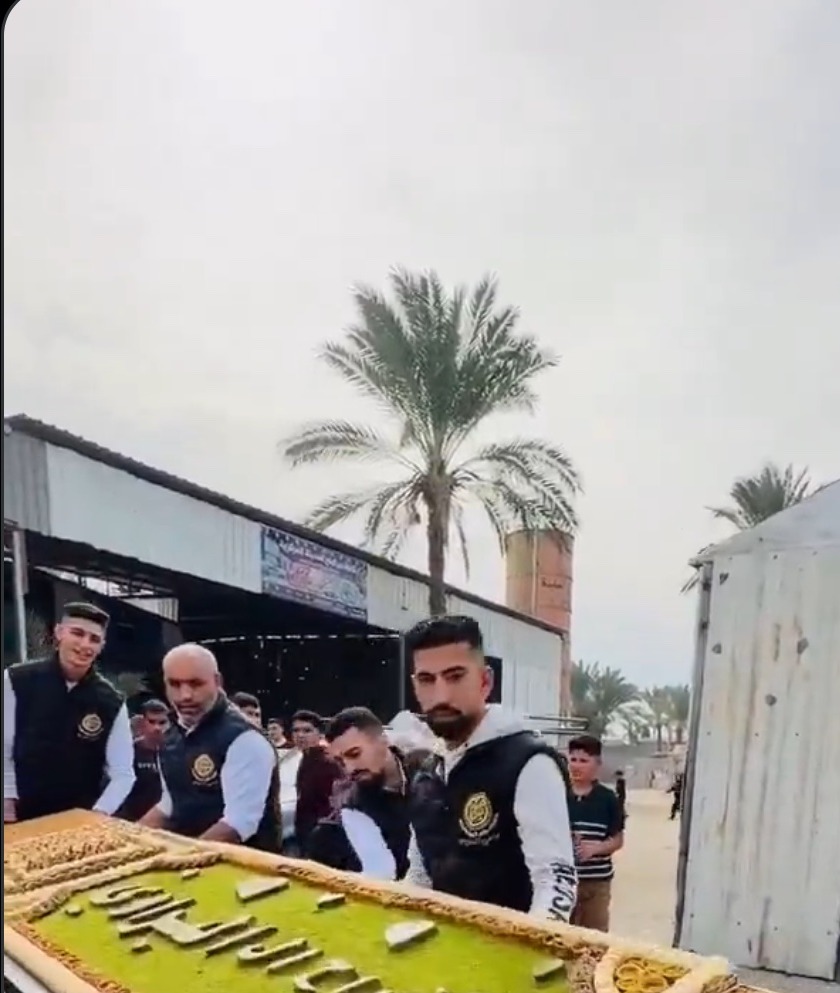
A separate sweets photograph makes the same point from the other side. A post by Daniel Wachtel shows men in matching vests carrying an enormous inscribed tray of kunafeh and baklava — for the Al-Abrawi family’s wedding. A different family from Abu Asous. Giant inscribed sweets trays are a Gaza wedding tradition, built from flour, sugar and syrup stretched to feed hundreds, and the photograph’s own background — corrugated sheds, a tent, a water tower — is not a luxury venue. It is a surviving pre-war sweets company working outdoors, in the open, where its hall used to be implied.
Where are the women?
The question the posters ask most — “where are the women?” — has a plain answer: at their own party. A Palestinian wedding is not one event. It is a sequence: the groom’s men’s launch party — an outdoor dabke night, which is what this footage shows — and the women’s celebration, the henna, held separately and privately. The split is a wedding tradition, centuries old across the Levant, among Muslim and Christian families alike, varying by family. It is not a religious law excluding women from a wedding they are part of; the women’s side exists, and it is simply not filmed for public posting.
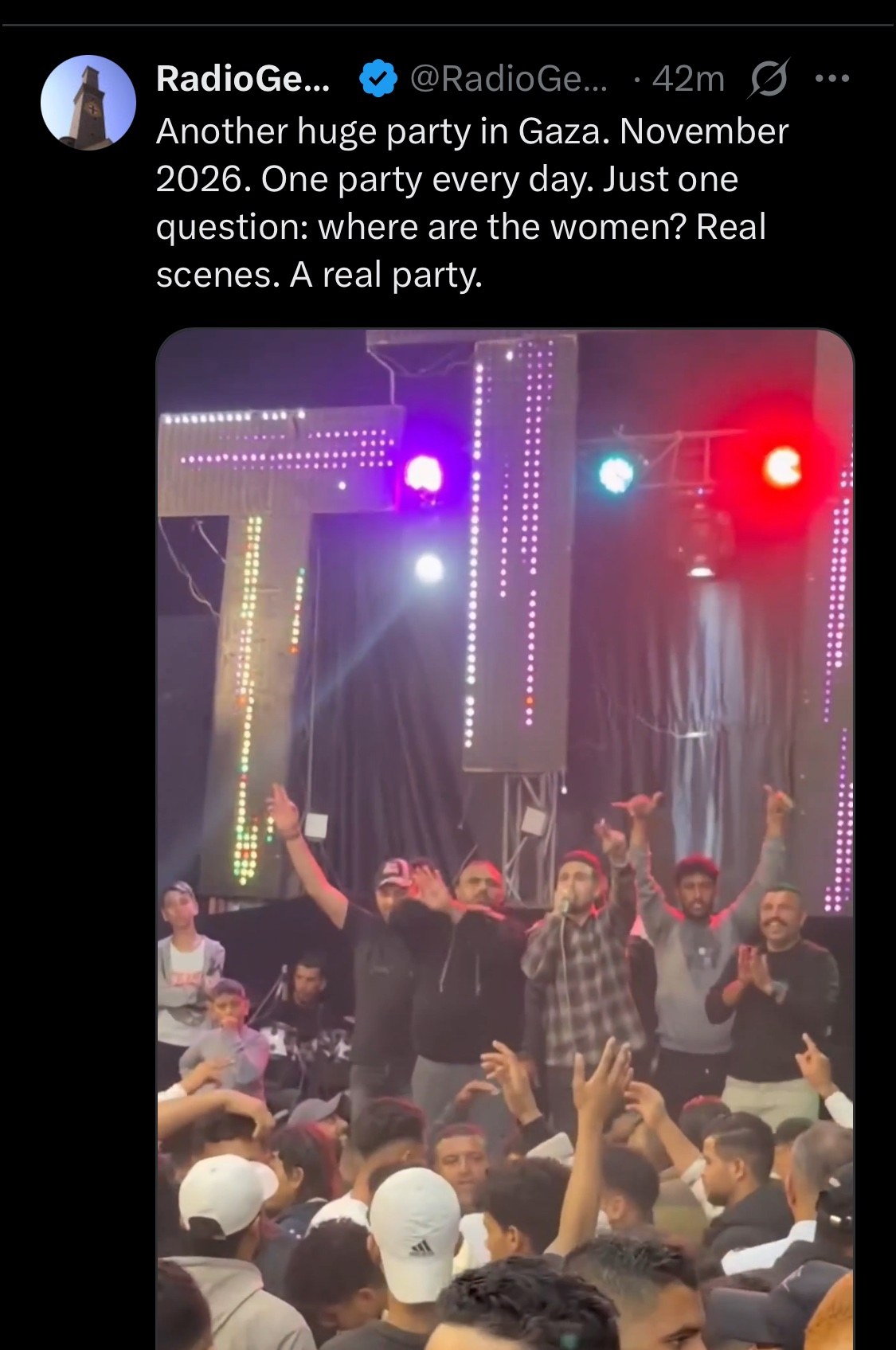
Criticizing the groom’s launch party for having no women is like criticizing a bachelor party for not having women at the party. The men’s-only format is the point of that particular celebration. Its absence of women is evidence of exactly one thing: that the viewer is watching the men’s event, the one part of a multi-day wedding that happens outdoors, in public, in front of cameras.
The bakery clips
The same morning brought a second wave of footage: a bakery case full of donuts and croissants, and piles of foil-wrapped chocolates. The account Kosher posted the chocolates under the caption “Starvation and famine in Gaza.” Eyal Yakoby posted the bakery display with the claim that “billions of dollars of the Muslim Brotherhood propaganda” had been “destroyed with a singular video from Gaza.”
Both clips come from the same single source — and the source marks are visible in the frames. Each carries the same location tag, “Mazaj,” the same Instagram handle, @NATALIE_FAISAL, and the same “Rabbi Poupko” credit bar at the foot of the clip: two accounts, one morning, one relayed video, presented as two independent proofs.
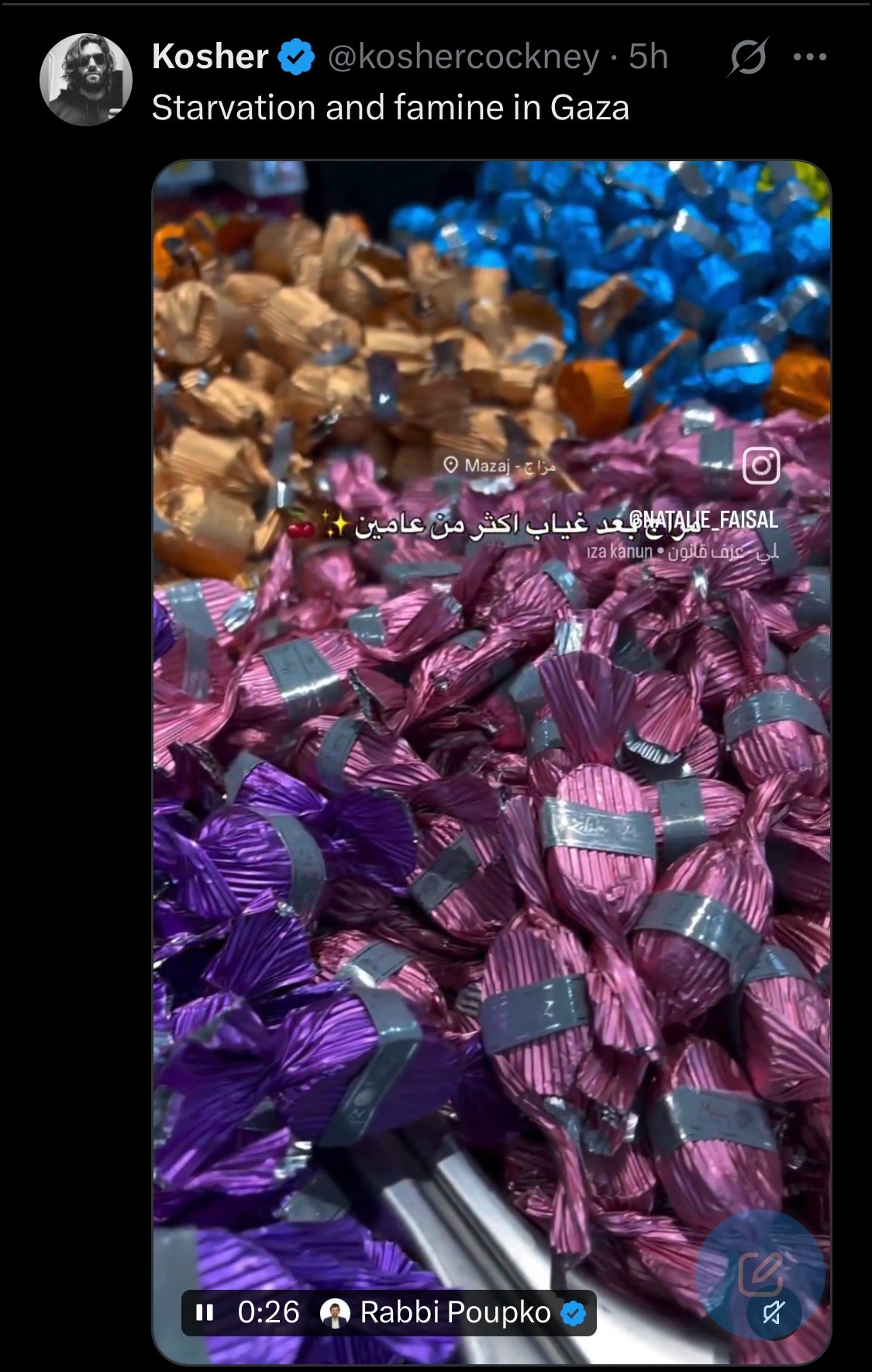
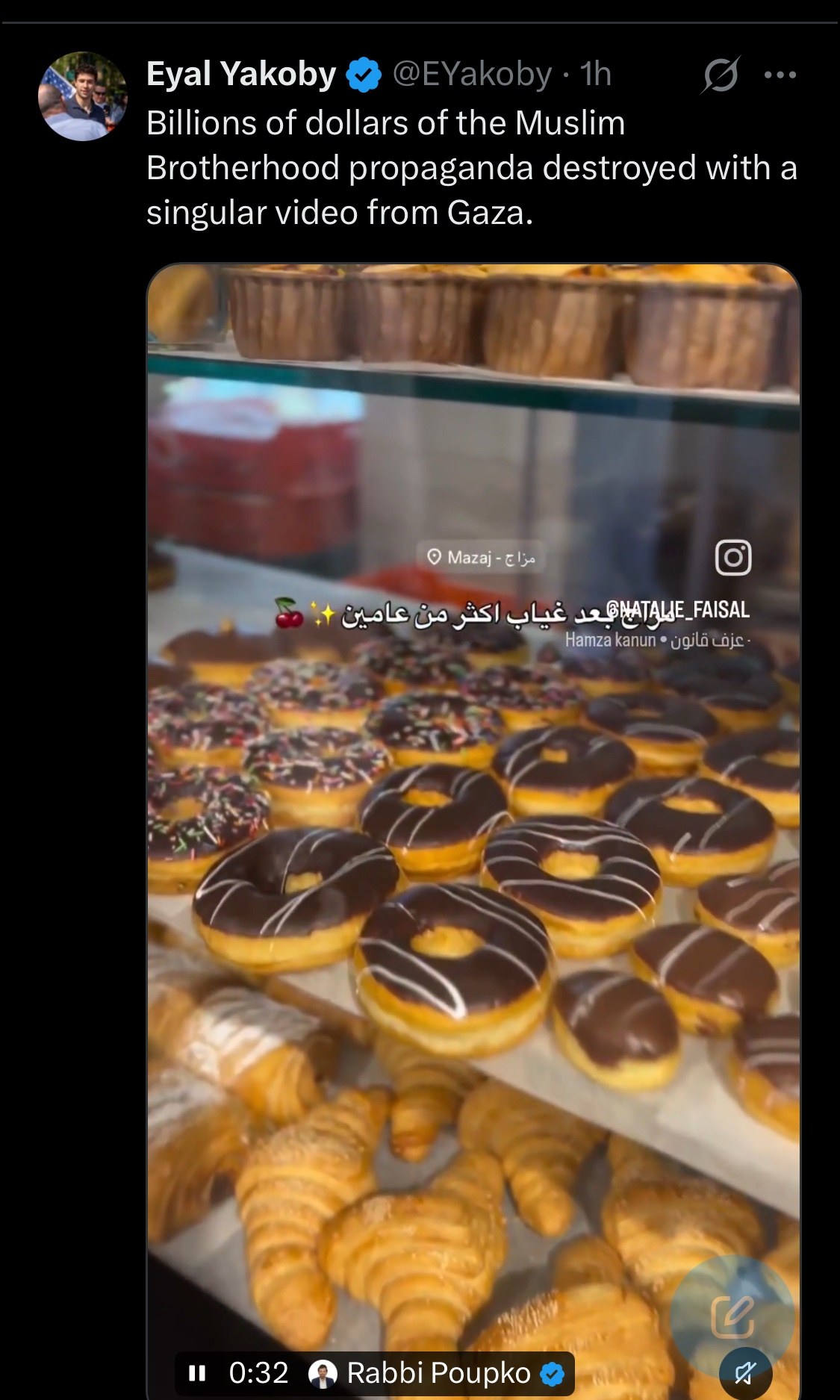
And the source text says the opposite of the use it was put to. The Arabic text on the footage reads: “Mazaj — back after an absence of more than two years.” It is a café announcing its return after being closed for more than two years of war. The video offered as proof that nothing happened is a video of a business coming back from having been gone.
One morning, everywhere at once
The events are spread across more than two weeks. The posts are not. Set side by side, the two timelines are the story:
| When | What happened |
|---|---|
| Nov 6 | 250 couples marry at Gaza City’s Sea Club, funded by the UAE’s Operation Gallant Knight 3 |
| Nov 9–11 | The camel wedding clip circulates — from Hebron, West Bank; police make arrests |
| Nov 15–16 | GAZAWOOD montages stitch celebration clips from multiple places into Gaza-branded streams |
| Nov 20–21 | Al-Dawla Media films and posts the Abu Asous launch party, Gaza City |
| Nov 22, 1:42 AM | Dean Cain quote-posts GAZAWOOD: “Stop the genocide!” |
| Nov 22, morning | RadioGenoa posts the party three times, including “Another huge party… where are the women?” |
| Nov 22, morning | Joana Cotar (Germany), Daniel Wachtel, GAZAWOOD, Kosher and Eyal Yakoby post within the same hours — the bakery clips tracing to one shared source |
Nothing in the record names a coordinator for that morning — and this article does not claim one. What is documented is simultaneity: footage from at least four different events, in at least two different territories, surfacing as a single argument, in several countries, inside a few hours, in the same sarcastic register. Whether that is coordination or a pile-on is a judgment; the timeline underneath it is a fact.
What is also documented is that Israel’s government has paid for exactly this kind of narrative work before. In June 2024, the New York Times reported that Israel’s Ministry of Diaspora Affairs had allocated about $2 million to a Tel Aviv firm, Stoic, to run a covert influence campaign: hundreds of fake accounts posing as Americans, ChatGPT-written comments, aimed at U.S. lawmakers over the Gaza war. Meta banned the firm; OpenAI disrupted its operation, which it called “Operation Zero Zeno.” The ministry denied involvement.
The second version was filed with the U.S. government itself. Foreign Agents Registration Act filings of September 26, 2025 show Bridges Partners LLC — routed through Havas Media Germany, working for Israel’s Foreign Ministry — running the “Esther Project”: up to roughly $900,000 to pay 14 to 18 American influencers about $7,000 per post, 25 to 30 posts a month, through the second half of 2025. And in September 2025, Benjamin Netanyahu personally sat down with pro-Israel influencers in New York to discuss securing American public support on social media.
The timing has a domestic address, too. The wave lands while Netanyahu’s hold on power is being contested in the open: Gadi Eisenkot holds the mandate to form a government, with a December 6 deadline; Likud has issued ten conditions for joining one, including Netanyahu keeping the prime minister’s job for a full term; Naftali Bennett has publicly committed that Netanyahu will not lead the next government and that his party will not join a Netanyahu bloc under any circumstances. A narrative that Gaza “isn’t a big deal” is worth more, this month, to one Israeli politician than to any other.
How a wedding gets lit in a city with no grid
The string lights are the detail posters point to first — and they are the detail with the most ordinary explanation. Gaza’s power grid effectively no longer exists. The World Bank, EU and UN damage assessment of April 2026 found more than 90% of electricity infrastructure destroyed or inoperable, over $560 million in damage. Of the ten pre-war Israeli feeder lines, exactly one operates — a 4-megawatt line supplying a single desalination plant in the south. No feeder line supplies households anywhere in the Strip.
So a lit event is a hired rig, and hiring one is the documented norm. Gaza entered the war with roughly 350 private neighbourhood generators and one of the world’s highest rates of rooftop solar. In 2025–26, private generator power sells in central Gaza at about 30 shekels per kilowatt-hour, roughly eight times the pre-war price (Mondoweiss, October 2026). The pre-war wedding halls on al-Rashid Street are rubble; the parties now happen in repurposed homes and shops, at double or triple pre-war prices — the price explicitly covering photography, decorations and electricity, “extremely expensive due to fuel shortages” (The New Humanitarian, April 2026). A few hours of light, bought at a punishing price for the biggest night of a family’s life, is not a grid. It is a generator.
The clean clothes and fresh haircuts have the same kind of record. Barbers never stopped working: AFP filmed one reopening amid the rubble of Bureij in June 2024; Anadolu filmed another in January 2025 cutting hair atop his own destroyed home, with tools salvaged from the wreckage; Al Jazeera filmed a tent salon in Shujaeya in March 2025 whose clients were preparing for a wedding. Clothes are hand-washed — a camp washing-machine project launched in 2026 was reported as the first of its kind in three years — and families keep their best clothes for occasions, as families everywhere do. In the week of November 10–16 alone, aid partners distributed 9,049 winter clothing kits (OCHA).
The food, too, is pooled — that is documented, in almost these words. “Friends and relatives contribute what they can, including clothes, shoes, cosmetics, food preparation and labour… turning marriage into a shared social project” (ImpACT International, November 2026, citing Al Jazeera). Diaspora relatives send money; neighbours cook. Even so, the scale is wartime: one Gaza City wedding served kunafeh but dropped the mini cola cans at roughly $3 each (The New Humanitarian); a Rafah tent wedding’s feast, in January 2024, was a few packaged snacks (Reuters). The mass weddings — 54 couples in Khan Younis in December 2025, 300 in Deir al-Balah in April 2026, 250 at the Sea Club this month — were funded outright by the UAE’s Operation Gallant Knight 3, clothing and food packages included.
Full shelves, empty wallets
The bakery footage proves goods exist. The same week’s UN reporting answers the question that actually matters: who can buy them. OCHA’s situation report of November 18, 2026, citing the World Food Programme’s October market monitor, records that commercial truck entries fell from 129 a day in September to 60 a day in October, and that 75% of households report difficulty accessing markets — 96% of them citing money, not absence of goods. Prices average 207% above pre-war levels. The Palestinian centre ICSPR put the distinction in one sentence: “The presence of goods on shop shelves does not guarantee food security if prices exceed families’ means.”
| Gaza in November 2026 | The figure |
|---|---|
| People displaced | More than 1.7 million |
| People facing acute hunger | 1.4 million |
| Households reporting difficulty accessing markets | 75% |
| Of those, citing financial constraints | 96% |
| Average food and essentials prices vs. pre-war | +207% |
| Unemployment | About 80% |
| Fatalities reported since the October 2025 ceasefire | 1,650 |
That table is the baseline the party footage is being used to erase. Households eat protein about once a week. The World Food Programme cut its assistance by a third in the period covered by its November 21 report, and its country staff say, in the UN’s own summary, that “it does not feel like a ceasefire.”
The city around the party
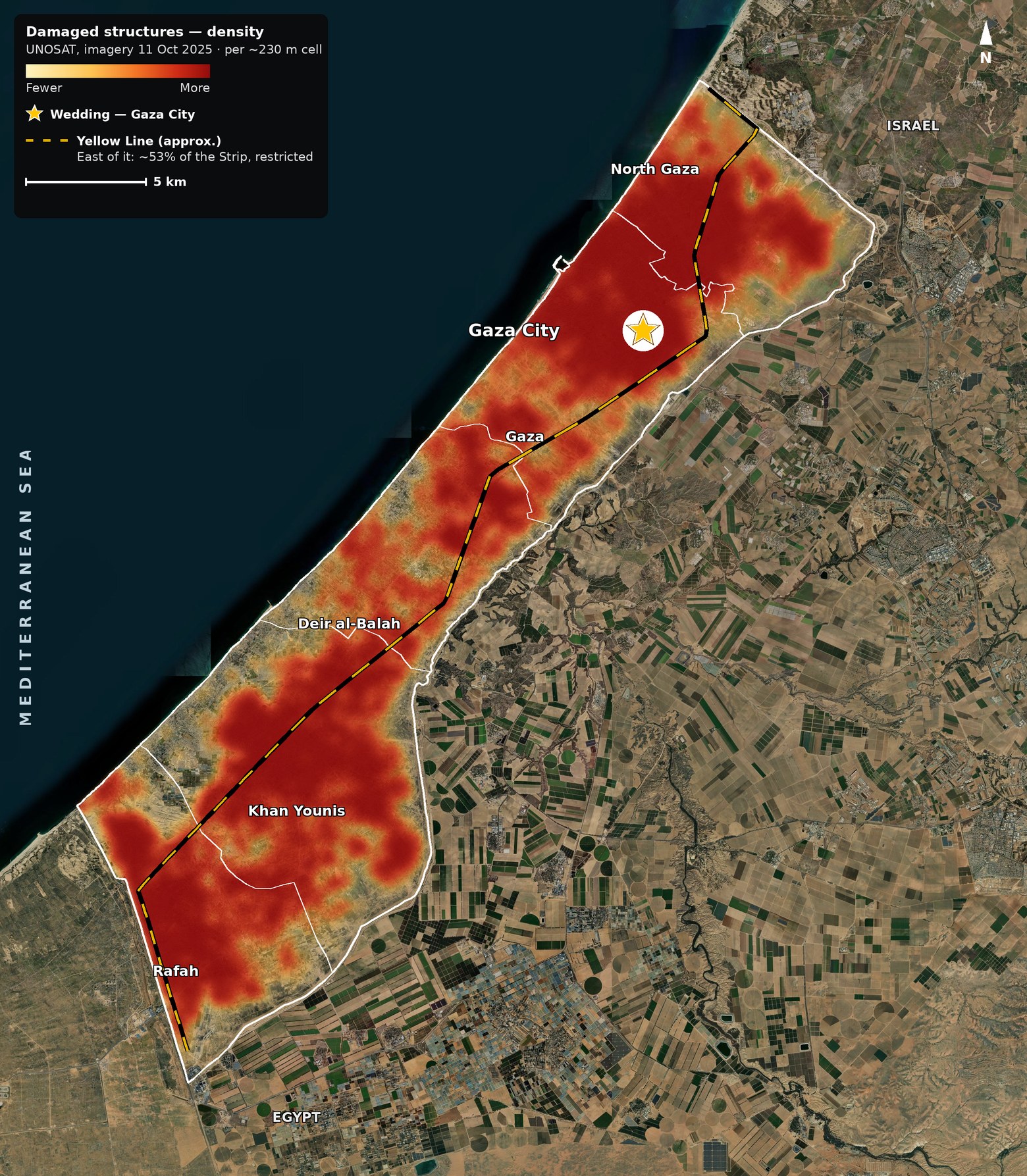
The wedding was held in Gaza City. Here is Gaza City, from the United Nations’ satellite assessment. UNOSAT’s comprehensive damage assessment — the latest published map and data, from imagery of October 11, 2025 — counts 198,273 structures damaged across the Strip, about 81% of everything standing before the war. Its June 2026 update raises the total to 201,290 structures, about 82%, including 134,422 destroyed and 328,627 housing units damaged. For Gaza City itself, UNOSAT’s dedicated assessment found 83% of structures damaged.
| Governorate | Structures damaged (UNOSAT, Oct 2025) |
|---|---|
| Khan Younis | 51,885 |
| Gaza | 51,530 |
| North Gaza | 41,454 |
| Rafah | 35,307 |
| Deir al-Balah | 18,097 |
| Total | 198,273 |
The map shows what the counts mean street by street. The damage is not evenly spread — it follows the cities: Gaza City and the north, Khan Younis, Rafah. Nearly all of Gaza’s roughly 2.1 million people are now concentrated in the coastal band west of the ceasefire’s Yellow Line, in less than half the territory, 1.43 million of them in tents (OCHA, November 2026). Deir al-Balah, in the centre, is comparatively functional — the lowest damage count, the aid hub — and even there, 86% of schools are damaged. Western Gaza City, where the Sea Club hosted 250 couples this month, functions in pockets inside a city that is 83% damaged. Both things are in the same satellite image. That is the point of the image.
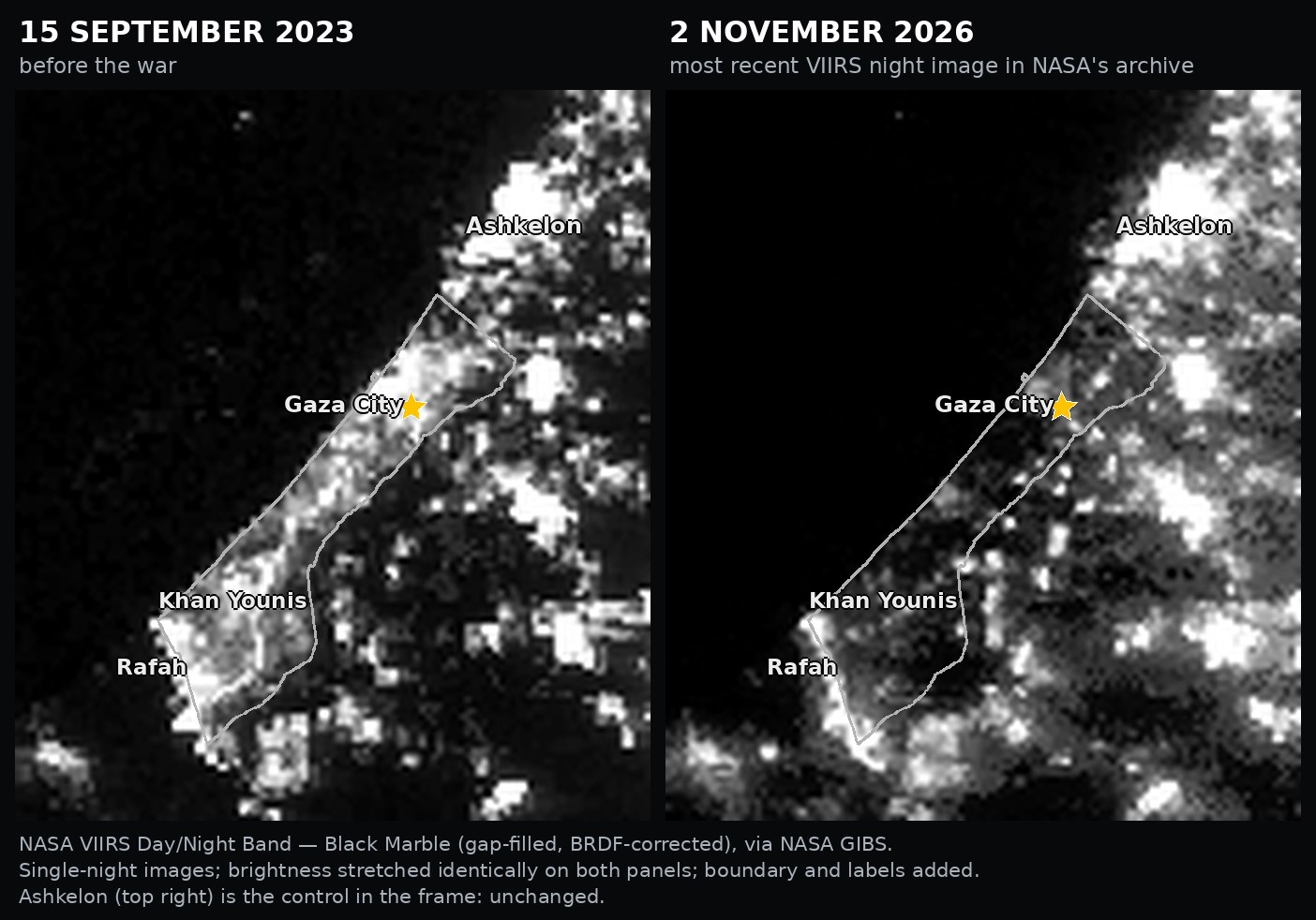
At night, the Strip has gone dark — measurably, from orbit. Night-light analysis by CARE and Wuhan University found Gaza’s light down 84% Strip-wide by March 2024, and down 91% in Gaza City. AFP’s analysis of NASA’s Black Marble data, in July 2025, found Gaza seven times less bright than before the war, Gaza City’s radiance divided by sixteen, with the only reliably lit points being generator-powered hospitals. The before-and-after rendered with this article — September 2023 against November 2, 2026, the most recent night image in NASA’s archive — shows the same thing in a single frame: a coastline that used to glow, gone dark, while the Israeli city of Ashkelon in the same image burns as brightly as ever. Against that darkness, one wedding’s string lights are not a refutation. They are a rental.
A wedding is not a verdict
The legal question was never whether life continues. It is what the Genocide Convention actually says. Article II defines genocide as acts committed “with intent to destroy, in whole or in part, a national, ethnical, racial or religious group, as such.” In whole or in part. The test is intent and acts — not the absence of weddings, bakeries, barbers or joy. A fact-checker that has graded this exact genre of post — Kashif, November 8, 2026 — rated the pairing of genuine celebration footage with genuine suffering footage, to insinuate the suffering is staged, as Misleading.
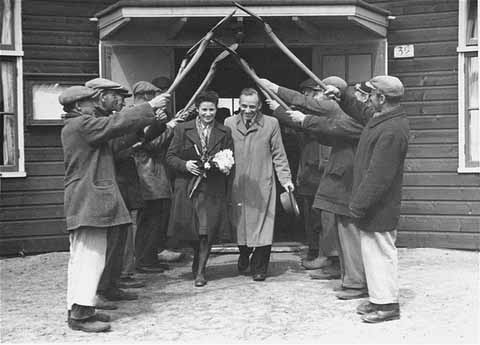
History already ran this experiment, and kept the photographs. The U.S. Holocaust Memorial Museum holds more than 496 Jewish wedding photographs — from occupied Europe, from transit camps, from the Warsaw Ghetto. Couples married at Westerbork transit camp, walking out of a barracks under an arch of raised sticks held by other prisoners. Couples married in the Łódź Ghetto, posing in their best clothes for Henryk Ross, who buried his negatives in the ground so the evidence would survive. No historian has ever offered those weddings as evidence against the Holocaust, because they are not. They are evidence of what people do inside a catastrophe: they marry anyway.

Sarajevo kept count, too. During the siege, 1,572 weddings were performed in a single Sarajevo municipality — some in a shelled registry office, grooms in uniform. The siege is not in doubt. Neither is the wedding count. Both are in the record, and the record holds them without strain, because a siege — like a genocide — is measured by what is done to a people, not by whether that people manages, on some nights, to dance.
Our read
The footage is honest. The argument built on it is not — and the dishonesty has a shape you can check. Take four different celebrations, filmed across two weeks, in two territories. Strip out the rubble at the edges of the frame — except when the rubble is the frame, as in the red-wall clip, where the party is held in front of bombed buildings and nobody mentions it. Add one bakery that announces, in its own text, that it was closed for two years. Present all of it, in one morning, in one sarcastic register, as a single picture of a place where nothing is wrong. Every individual piece is real. The picture is false.
Notice what the argument needs you to believe about how genocide works. It needs genocide to look like a place where nothing ever happens but dying — no haircuts, no music, no weddings, no donuts — so that any sign of life breaks the spell. That has never been how it works, anywhere, including in the cases the world has already judged. The Holocaust Museum’s wedding photographs are not a loophole in the Holocaust. They are what the inside of it looked like on the days people refused to only die. Gaza’s weddings are the same kind of evidence, pointing the other way from the one claimed: a population under documented, satellite-counted destruction, marrying in front of it.
And notice the calendar. This wave did not arrive on a random morning. It arrived while a prime minister who has been documented — by the New York Times, and by filings with the U.S. Justice Department — as a beneficiary of paid narrative operations fights for his political life against a December 6 deadline, needing the world, and his own public, to believe Gaza is not a big deal. We do not claim this wave was bought; no document says so, and we say so. We claim it was useful, that it was built from real joy cut into a false picture, and that the people in the footage — a groom, his friends, a reopened bakery — deserved better than to be used as the alibi.
A wedding is not a verdict. It never has been. The verdict is in the satellite images, the market monitors, the night lights that went out — and those records are not ambiguous at all.
Sources: UNOSAT Comprehensive Damage Assessment (imagery October 11, 2025; June 2026 totals via UN media and the Palestinian Central Bureau of Statistics) and Gaza City assessment (September 2025); OCHA Humanitarian Situation Report, November 18, 2026, and Access and Movement map, November 2026; World Bank/EU/UN Rapid Damage and Needs Assessment, April 2026; WFP External Situation Report, November 21, 2026, and October 2026 Market Monitor; EMERGENCY, October 15, 2026; ICSPR, October 29, 2026; CARE/Wuhan University night-lights analysis, March 2024; AFP analysis of NASA Black Marble data, July 2025 (night-lights pairing rendered from NASA GIBS VIIRS data, September 15, 2023 and November 2, 2026); The New Humanitarian, April 15, 2026; Reuters, January 19, 2024 and October 19, 2026; AP, December 2, 2025; Reuters Connect/Anadolu, November 6, 2026; ImpACT International, November 2026; Al-Shabaka, May 2026; Mondoweiss, October 2026; AFP TV, June 2024; Anadolu, January 2025; Al Jazeera, March 2025; TPS-IL, November 11, 2026 (Hebron); New York Times, June 2024 (Stoic); U.S. Department of Justice FARA filings, September 26, 2025, and Jewish Telegraphic Agency, September 30, 2025 (Esther Project); U.S. Holocaust Memorial Museum (wedding photographs; Westerbork image via Jewish Virtual Library; Łódź Ghetto image by Henryk Ross); Sarajevo Times (siege weddings); Kashif fact-check via WhatTheFact, November 8, 2026. The viral posts are as captured November 22, 2026. Not verified, and flagged in the text: the Sabra neighbourhood detail (a Grok reply only); any camel presence at the Abu Asous wedding; and any coordination or payment behind the November 22 posts — the simultaneity is documented, a central director is not.
Why this is on PoliVion
PoliVion tracks the pro-Israel money network in America’s elections — the network that sustains the government whose documented narrative operations run through this story. The money, and the map, are here.
We Don’t Talk About October 7th → See the network map → All PoliVion articles → ← Back to the dashboard